30 April 2011

A Powerful Arm; An Enfolding Embrace

Extracted from a sermon by Reginald Mallett, late British Methodist evangelist:
When I was very young I held my father in awe. If I wanted any favors then I would go to my mother. She acted as the go-between. One Sunday night I experienced a revelation about his nature that changed my whole perception and banished my fear. I was about seven years old. Dad took me to evening service at the parish church because my older brother who was in the choir was to sing a solo. Mother stayed at home to look after my two younger brothers. I sat in that historic stone church with its high polished mahogany pews struggling to remain interested until my brother had sung. Then, like a normal seven year old I became utterly bored and began to feel sleepy. I gazed at the soaring gothic arches and the stained-glass windows. The service from the old prayer book seemed to go on forever. Finally the rector mounted the steps to the large stone pulpit and began his sermon. He had a remarkably soft, soothing voice. It was a special gift for any insomniac! It was able to coax the most alert into a gentle slumber. That evening I was fighting to stay awake - and losing the battle. My head nodded and then it nodded again, this time a little lower. Sleep was beckoning. At that moment I noticed my father's right hand move. I cringed expecting a slap to wake me up. Instead I found his powerful arm come round my shoulder as he gently pulled me down to rest my head on his lap so I could sleep in comfort.

How many think of God as the One with the big stick? They cringe waiting for the slap rather than joyfully anticipating an enfolding embrace. Despite what we sing and say, many of us have not truly received the good news that God has been revealed as love. It is time for us to claim our right to the glorious freedom of the children of God. It is time for us to receive the assurance that we are held firm in the heart of the Holy One.

25 April 2011

"Good" Friday without the Resurrection?


I posed a question this morning on twitter: Could we still call it "Good Friday" were it not for the Resurrection of Christ?

Before I give some of the insightful responses that were given, I want to share a little bit of where this question comes from:

1. In the introduction to yesterday's sermon, the pastor said that even if Jesus had not been raised from the dead that the story that led to the crucifixion would have been the greatest story ever...a story of love and sacrifice beyond human comprehension. My wife and I immediately reacted with confused looks to one another later conversed together, asking: "Would that really be true? Wouldn't love have actually lost if it remained dead? Wouldn't this simply echo the mantra 'Life sucks, then it's over' that we so often hear today?" Aside from what we thought was a bewildering statement, the sermon was filled with the power of the resurrection and its significance for us even today!

2. One of the criticisms of penal substitutionary atonement (PSA) is that it doesn't require or have any real appropriation of the resurrection of Jesus. That Christ died to pay the penalty for our sins is enough. This is not to say that those who hold to PSA don't believe in the resurrection, but that they often separate the atonement from the resurrection and don't see them as related (necessarily anyway).

3. Some Asbury University students approached me at the library one night last week and asked, "Why do we call it 'Good' Friday?" In one sense we see it as the greatest of tragedies in a perfectly innocent One to taste such a brutal, shameful, and lonely execution. On the other hand, we see the atoning work and forgiveness given and displayed in this One who died though he is righteous. My answer, though, also included that we call it 'Good' in light of what happens on the third day - resurrection!

So these interactions and ideas framed the context from which the "poll" question arose. I received some thoughtful replies that added to what is above in the following responses:

S: No. Good Friday would be equivalent of a day set aside for a martyr who taught nice things, but without authority.

A: Yes. It's Good also because our sins were atoned for... in the same way that medieval Christians referred to The Fortunate Fall

D: atonement without resurrection is good, but not Good because it doesn't accomplish the larger end of giving life.

A: forgiveness of sins is more than we can ask for. Anything else is gravy

D: I agree, but there's so much gravy! and would forgiveness alone, while amazing, have done all Christ said he came to do?

A: I think the question was is it Good Friday without the Resurrection. Yes. That said, I don't separate them.

I posted a note from John Wesley on Friday about redemption. He suggests that forgiveness is the beginning of redemption and that resurrection is the completion of it. If right, then a Good Friday without the resurrection would be an incomplete work...at least in terms of 'redemption,' which is a theme of atonement theology, is it not?

However (and perhaps this was A's point above), in the atoning sacrifices of Leviticus, we don't see the necessary implication of resurrection, do we? So perhaps the related question is whether we could consider the sacrifices as "good" insofar as they reconcile God with God's people. Applied to Christ, was his death all that was necessary to atone for our sins and/or reconcile us to God? Or was the resurrection a part of this too? Paul, in Romans 4.25, seems to place these together, especially if we understand justification in terms of forgiveness or pardon, as Wesley did [not that we are bound to his definitions :) ]. He was delivered over to death for our sins and was raised to life for our justification.

What do you think? How much of Friday's 'Good'-ness is derivative of what happened on the third day? And perhaps the question that challenges those like me, who hesitate to call it 'Good' without the resurrection is this: What did Jesus mean by crying 'It is finished!' from the cross? (That last question may need to be addressed in another post.)

22 April 2011

On Redemption

One of the more beautiful lines from John Wesley on redemption comes in his note on Colossians 1.14, "In whom we have redemption through his blood, even the forgiveness of sins." When it comes to themes and pictures of the atonement, this line illustrates a nice mosaic, expressing an array of layers at work in Christ's redemption via his death and resurrection:

The voluntary passion of our Lord appeased the Father's wrath, obtained pardon and acceptance for us, and, consequently, dissolved the dominion and power which Satan had over us through our sins. So that forgiveness is the beginning of redemption, as the resurrection is the completion of it.

21 April 2011

From Distress to Composure

The scenes in the Garden of Gethsamene on the night of Jesus' arrest have always stood out to me. I cannot grasp what level of distress and sorrow that Jesus felt on the eve of his torturing and lonely death. St. Luke tells us that he was in such anguish that he began to sweat drops of blood (22.44). I just read a sermon by Dr. Mallett on prayer and he speaks of Jesus' cry in the Garden of Gethsemane:
The church never forgot that when Jesus was laying out his soul to God in the extremity of his inner anguish in Gethsemane, he summed up his relationship by crying "abba." This was not simply "father." It was much more familiar than that. Perhaps the first word a Hebrew child uttered would be "abba"-daddy.
It expresses and fulfills the intimacy conveyed in how he had earlier taught his disciples to pray, which included a prayer for deliverance from evil. When I have been teaching Sam to pray, I've used the words: "When trouble comes our way, rescue us." I'm sure this doesn't capture everything in Deliver us from evil/the evil one but I think it at least partly corresponds. It seems there is something of this in If it be possible, let this cup pass from me. But ultimately Jesus submits his will to that of his daddy and trusts that he will be with him, to strengthen him, in the midst of the trouble that is heading his way.


Then the story transitions from anguish to an almost unbelievable sense of composure and calmness in Jesus as he is arrested. I came across John Wesley's notes on how Jesus responds in the midst of being arrested...
The heroic behaviour of the blessed Jesus, in the whole period of his sufferings, will be observed by every attentive eye, and felt by every pious heart: although the sacred historians, according to their usual but wonderful simplicity, make no encomiums upon it. With what composure does he go forth to meet the traitor! With what calmness receive that malignant kiss! With what dignity does he deliver himself into the hands of his enemies! Yet plainly showing his superiority over them, and even then leading as it were captivity captive!
What a remarkable transition from anguish and distress to composure and calmness. With his daddy, Jesus is not afraid to pour out his soul in anguish. With his enemies who seek to do him harm, he is cool and graceful. His submission is immediately put to the test after his prayer and he is full of grace and mercy.

18 April 2011

Charles' Conversion Hymns: Guest post...

If you're a returning reader to my blog, you've probably seen me make reference to Jonathan Powers, a doctoral student in worship studies at the Robert Webber Institute of Worship Studies. Jonathan is a gifted musician and insightful thinker into the relationship between theology and worship as you can read at his blog, Theology in Worship. He is also a Charles Wesley expert/scholar and I have enlisted his help on several posts and have enjoyed the correspondence we have shared during our studies. Jonathan was especially helpful in my recent series on the great Charles Wesley hymn, 'And Can It Be?' It is only fitting then that a good follow-up to that series would be written by him, so I am grateful for his input in what is below as he has gracefully taken time to write a guest post. Enjoy!

Charles Wesley Conversion Hymns


Charles Wesley’s primary inspiration for his lyrical writing came from his own evangelical experience, one very similar to his brother John’s heart-warming experience.


In the month of May 1738, the Wesleys were in London. Charles was recovering from an illness in the home of some Moravian friends. On Pentecost Sunday, his brother John and some friends stopped by to visit Charles on their way to church.
Later that morning, while in bed, opening his Bible to Isaiah 40:1, Charles felt God’s salvation come upon him. His Journal entry for May 21st reads: "I now found myself at peace with God, and rejoiced in hope of loving Christ..... I saw that by faith I stood, by the continual support of faith.......I went to bed still sensible of my own weakness....yet confident of Christ's protection." Just three days later - May 24th - John himself found assurance of salvation during a meeting in nearby Aldersgate Street.

Exactly a year after his own conversion experience, Charles wrote the famous hymn, “O for a Thousand Tongues to Sing,” which he recommended for singing "on the anniversary of one's conversion."

It was upon the experience of salvation in Christ that Charles Wesley began to find a specific message in his songwriting. Lyrical expression was more than a cathartic outlet. Instead, Wesley deeply felt the importance of communicating the theme of God’s universal invitation to salvation. Many of his hymns would thus reflect upon the experience on conversion. John Lawson writes, “It is natural to find that the Wesley hymnody contains a great volume of writing celebrating the glory of the conversion experience.”[1] With this personal assurance and experience of conversion, Charles began to place a new emphasis and power within his lyrical verse. John Tyson writes, “The bondage to sin and the darkness of doubt had been broken and driven away when Christ came into the poet’s life. Charles Wesley used images of manumission and liberation to communicate the freedom that he now felt because of his faith in Christ.”[2]

It is important to note that Charles saw his evangelical experience as a biblical one. Teresa Berger writes, “…the theme of God’s universal invitation to salvation is clearly at the foundation of Wesleyan preaching and the call to conversion.”[3] Often, Charles would reflect upon this experience by placing himself within certain passages of scripture. This is reflected in hymns such as “Come, O, Thou Traveler Unknown” and “And Can it be That I Should Gain?”

The first of these hymns, “Come, O, Thou Traveler Unknown,” is also known as “Wrestling Jacob.”
Charles takes an “inside-out” allegorical approach within this hymn. He places himself inside the story as if it is part of his own testimony, and reinterprets the scripture thusly. In particular, “Wrestling Jacob” is a meditation on Charles Wesley’s own conversion through the story of Jacob and the angel found in Genesis 32:22-32. Charles becomes a figure of Jacob while the angel becomes a figure of Christ.

Though “And Can it be” is not as overt an allegory, Charles is still able to navigate through his own conversion by way of scripture. Verse four in particular reflects upon the freeing of the prisoners in Acts 12 as similar to Charles’ own experience of the freedom found in Christ. This verse may be one of the most robust verses in all of hymnody reflecting upon the transformative power of God’s grace.


Setting these reflections to hymn-form, Charles Wesley provided a scriptural language through which people of the church could reflect upon their own conversion experience while simultaneously worshiping God.
Hence, for Charles Wesley the inner experience of salvation was manifest through lyrical praise of God.


[1] John Lawson, A Thousand Tongues: The Wesley Hymns as a Guide to Scriptural Teaching. (Atlanta, GA: Paternoster Press, 1987), 124-125.

[2] John R. Tyson, Assist Me to Proclaim (Grand Rapids: William B. Eerdmans Publishing Company, 2007), 50.

[3] Teresa Berger, Theology in Hymns?: A Study of the Relationship of Doxology and Theology According to A Collection of Hymns for the Use of the People Called Methodists (1780) (Nashville: Kingswood Books, 1995), 109.

16 April 2011

In Memoriam - And Can It Be?

And can it be that I should gain
That Thou, my God, shouldst die for me?


Over the last few days I've blogged some of my thoughts and interaction with the lyrics of what is often called the 'Fight Song' of Methodism: 'And Can It Be' (or 'Free Grace,' which was the title Charles Wesley first published it as). I posted an entry for each verse. Click on the verses above to go to each post.

But there is one more thing I wish to share with you about the significance of this song for me. Though I was raised in a Methodist church, I wasn't exposed to this song (that I can recall anyway) until I was in high school when a British Methodist evangelist, named Dr. Reginald Mallett, visited my hometown to preach at a cluster revival of the several nearby Methodist churches. You can read more about his ministry in this lovely article that was written immediately after his death last year.

Dr. Mallett had a very attracting preaching style. Perhaps it was just the penchant for British accents that people like me have (I think he's the only person who has ever referred to me as a "fine young chap"), but I found his delivery very appealing as he would repeat the Scriptural text or hymn line to serve as transitions throughout his sermons. One such repetition was the opening lyrics of this hymn. I recall the clarity and exactness of his British accent as he recited the marvelous words of wonder at the depths of God's love that we should gain an interest in the blood of Christ.

My family was keen on welcoming visitors (esp. visiting preachers) to share meals with us after church services. Dr. Mallett and his wife joined our family at my grandfather's house on one of the evenings that week of the revival. I was in the midst of considering my educational path in route to ministry, when he suggested, "If you're going to seminary, be sure to give a good look at Asbury." That was the first time I'd heard of the school and his advice would return to mind years later when I pondered transferring from Murray State to finish my undergraduate work in Religion or Theology or Bible. So not only did he introduce this hymn to me, he was the first to introduce me to the name of the institutions that bear my undergrad and seminary degrees, even though his recommendation was from a distance.

I didn't speak with Dr. Mallett again for quite some time, but since I started my PhD program in a British institution and occasionally go to England for brief residency periods for intensive research, I decided to look him up during my visit this past June. I found that he was living in the southern portion of England (a few hours away from Manchester, where my school is). I also discovered he was on facebook and requested him as a friend. We finally connected via facebook and email my last day there last June. He expressed his greetings and warm memories from his time in my hometown. I got to share with him the memories of our brief interactions and that his few words played a part in my educational and vocational journey. It was my hope that I would get to travel down to his town to visit him on a future trip to England, but he passed away three months later (as you can see in the article above).

So I close my reflections of this great hymn in memory of Dr. Reginald Mallett, for he played a significant role in the life and path of this "young chap." I'm confident that Dr. Mallett is clothed in righteousness divine and awaits the final day at the marriage of the new heaven and new earth when he shall, like we, claim the crown through Christ our own!

15 April 2011

And can It Be? (vi)

Verse 6
No condemnation now I dread;
Jesus, and all in Him, is mine;
Alive in Him, my living Head,
And clothed in righteousness divine,
Bold I approach th'eternal trone,
And claim the crown, through Christ my own.

We come now to the final installment of this sacred hymn written by Charles Wesley, and what an appropriate ending it is. Grounded on all that came before, this verse completes the race as we see the images of justification, sanctification, and even glorification (grace in the life to come in the new heaven & new earth) come together.

The first time I heard this hymn sung at Asbury Seminary, I recall vividly someone shouting "WOOOOOOO!!" at the first line of this verse. There was something liberating about that shout that comes to mind every time I sing this song now. We saw a beautiful picture of liberty from the bondage of sin in verse 4. Here we see another aspect of that in the blessedness of assurance of those who walk according to the Spirit. There's lots of debate about Romans 7 and the battle of the flesh against the law. Is this picture (of someone who wants to do what is right and not do what is wrong but finds himself not doing what is right and doing what is wrong) the expected norm or pattern for the life of the believer? Or, is Paul speaking in past terms...of someone who is trying to live according to the law apart from grace? If the latter, then the pattern of losing the battle against the flesh is not the expected norm of the life of the Christian, but is something from which God wants to set us free in Christ. Accordingly, when we are found in Christ, "There is therefore now no condemnation for those who are in Christ Jesus. For the law of the Spirit of life has set you free in Christ Jesus from the law of sin and death." If Christ has made our chains to fall off, there is nothing to be afraid of. We are free to follow him! And in that there is no need to dread condemnation anymore!

Another word on not dreading condemnation that stands out as Wesleyan to me is the language of 'perfect love' as it pertains to sanctification. In 1 John 4.17-18, we see this come to fruition: By this is love perfected in us, so that we may have confidence for the day of judgment, because as he is so also are we in this world. There is no fear in love, but perfect love casts out fear. For fear has to do with punishment, and whoever fears has not been perfected in love. This is at the heart of Wesleyan sanctification: perfection in love. And that is what can give us the confidence and boldness so exuded in this hymn.

This confidence takes a level that may draw discomfort to some of us who want to shy away from any sense of entrepreneurial spirit that makes us the master. Charles affirms, "Jesus, and all in Him, is mine...claim the crown, through Christ my own." Charles is not saying, "Jesus is mine...not yours!" He is also not saying, "I'm claiming him because I have the right to ownership of him." He's saying, "Jesus is mine because in the pursuit of righteousness, he's all that I can claim that can bring it to me...and he brings it by bringing himself."

The language of being "clothed in righteousness" is synonymous with justification. It is an external, or forensic, work of God in Christ indicating that Christ "justifies the ungodly" or covers our ungodliness with his godliness. Some stop righteousness there...that's as far as it goes and any sort of inherent righteousness of ourselves is postponed to life after death. The Wesleyan understanding of righteousness says that this clothing does something to and in us now. It begins to infect us, even now. Christ's righteousness actually is imparted into us as we wear his cloak. It purifies us today. It not only marks us as royalty but makes us royalty. And in that...because Christ is our own...when we approach the the throne we can do so with boldness and claim the crown.

Do note, however, that this is not a "pie in the sky, by-and-by" sort of picture. Wearing Christ's righteousness will take us down paths that will not be easy. It will require us to take up our cross. That is the life of sanctification...following Jesus. Martin Luther's final two theses of the 95 say this:
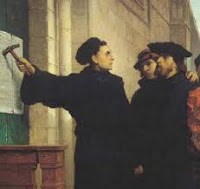
94. Christians are to be exhorted that they be diligent in following Christ, their Head, through penalties, deaths, and hell;

95. And thus be confident of entering into heaven rather through many tribulations, than through the assurance of peace.
Notice the common language of Christ as our "Head" between Luther and Charles' lyrics above. But to return to the opening lyric of this verse, for those who walk in accordance with the Spirit (i.e., following Christ) there is no need to fear condemnation. It is not a matter of whether or not you recall a decision made in a point in time. It is a matter of whether or not you are walking with him now. Christ's cloth of righteousness will not stay on us if we don't move and follow him.