Showing posts with label Charles Wesley. Show all posts

14 July 2011

A Wesleyan Appropriation of the Cry of Dereliction - Part 4

In concluding this series on exploring a Wesleyan interpretation of the cry of dereliction, we will pick up where we left off the last post, which appealed to Wesley's belief of Christ's human will as submissive to the will of God. This, in my view, leads naturally to what I see as the richest pastoral payoff for this passage.

It is worthy to note that in the sermon The Repentance of Believers, cited in the previous post, Wesley’s exhortation was that our will would be less self-directed and more in submission to the will of God. That is, Christ’s human will in subjection to the will of God is the image of our sanctification...what it looks like for someone who expresses his or her trust in God, even when God seems to be hiding or distant. I think we see this in Wesley’s interpretation on the beatitude, ‘Blessed are they that mourn, for they shall be comforted':
But he now ‘hides his face, and they are troubled:’ They cannot see him through the dark cloud. But they see temptation and sin, which they fondly supposed were gone never to return, arising again, following after them again, and holding them in on every side. It is not strange if their soul is now disquieted within them, and trouble and heaviness take hold upon them...Blessed are they who…steadily refuse all other comfort. They shall be comforted by the consolations of his Spirit.
Whether or not Wesley really had this connection of Christ and our sanctification in mind, I am unsure. But I cannot but draw this conclusion. The battle against sin and temptation is clearly in view, and by submitting to the will of the Father and only seek consolation through the Spirit, even when we ‘cannot see God,’ we move forward to victory in sanctification, just as Christ continued to pour out his heart to his Father even through death. 'Blessed is the one who steadily refuses all other comfort...' Sound like Christ on the cross? The Roman centurion even noticed that there was no enmity between the man who died on the cross and God, but even declared him as God's Son! The will that is submitted to God is not afraid to mourn or scream at injustice. It may just be the sign of someone who is more in tune with God (read: sanctification) than most everyone else. In this light, we might be well on our way toward a Wesleyan appropriation of the cry of dereliction and sing with John and his brother Charles Wesley, who once wrote,
O Jesu, let thy dying cry
Pierce to the bottom of my heart,
Its evil cure, its wants supply,
And bid my unbelief depart.

04 May 2011

Psalm 34

A psalm of David, when he changed his behaviour before Abimelech: who drove him away, and he departed.

1
I will bless the LORD at all times: his praise shall continually be in my mouth.

2My soul shall make her boast in the LORD: the humble shall hear thereof, and be glad.

3O magnify the LORD with me, and let us exalt his name together.

4I sought the LORD, and he heard me, and delivered me from all my fears.

5They looked unto him, and were lightened: and their faces were not ashamed.

6This poor man cried, and the LORD heard him, and saved him out of all his troubles.

7The angel of the LORD encampeth round about them that fear him, and delivereth them.

8O taste and see that the LORD is good: blessed is the man that trusteth in him.

9O fear the LORD, ye his saints: for there is no want to them that fear him.

10The young lions do lack, and suffer hunger: but they that seek the LORD shall not want any good thing.

11Come, ye children, hearken unto me: I will teach you the fear of the LORD.

12What man is he that desireth life, and loveth many days, that he may see good?

13Keep thy tongue from evil, and thy lips from speaking guile.

14Depart from evil, and do good; seek peace, and pursue it.

15The eyes of the LORD are upon the righteous, and his ears are open unto their cry.

16The face of the LORD is against them that do evil, to cut off the remembrance of them from the earth.

17The righteous cry, and the LORD heareth, and delivereth them out of all their troubles.

18The LORD is nigh unto them that are of a broken heart; and saveth such as be of a contrite spirit.

19Many are the afflictions of the righteous: but the LORD delivereth him out of them all.

20He keepeth all his bones: not one of them is broken.

21Evil shall slay the wicked: and they that hate the righteous shall be desolate.

22The LORD redeemeth the soul of his servants: and none of them that trust in him shall be desolate.

JW: David praises God for his goodness to himself and others, ver. 1 - 7; encourages the righteous to trust in him, ver. 8 - 10; exhorts them to fear God and depart from evil, ver. 11 - 14; God's favour to the righteous and displeasure at the wicked, ver. 15 - 22.

Title of the psalm. When - A psalm made upon that occasion, though not at that time, when he counterfeited madness. Wherein whether he sinned or not, is matter of dispute; but this is undoubted, that his deliverance deserved this solemn acknowledgment. Abimelech - Called Achish, 1Sam 21:10. But Abimelech seems to have been the common name of the kings of the Philistines, Gen 20:2 26:1, as Pharaoh was of the Egyptians.

3: 'Together' - Not in place, for David was no banished from the place of God's public worship, but in affection; let our souls meet, and let our praises meet in the ears of the all-hearing God.

5: 'Lightened' - Comforted and encouraged. 'Ashamed' - They were not disappointed of their hope.

8: 'O taste' - Make trial, of it by your own experience of it. 'Good' - Merciful and gracious.

9: 'Fear' - Reverence, serve, and trust him; for fear is commonly put for all the parts of God's worship.

14: 'Depart' - From all sin. 'Do good' - Be ready to perform all good offices to all men. 'Seek' - Study by all means possible to live peaceable with all men. 'Pursue it' - Do not only embrace it gladly when it is offered, but follow hard after it when it seems to flee away from thee.

16: 'The face' - His anger, which discovers itself in the face.

18: 'Nigh' - Ready to hear and succour them. 'To' - Those whose spirits are truly humbled under the hand of God, and the sense of their sins, whose hearts are subdued, and made obedient to God's will and submissive to his providence.

What a majestic psalm for the age and season of the resurrection! It is a psalm of hope for it looks to God's deliverance from affliction and trouble (which really came through affliction and trouble: think crucifixion/death) for those who put their trust in him and gives us hope for the future. They were not disappointed of their hope.

The command is to 'Depart!!' from evil, from all sin. This is why I came to verse 4 of 'And Can It Be?' when I thought of the resurrection and its sin-breaking, death-breaking power for us today and tomorrow! From the dark dungeon of death, God's face, God's eye diffused a quickening ray of light that bids 'Come awake!' and 'The grave no longer has a hold on you!' Jesus spoke of another 'Depart!' in the final judgment, but if we hear the 'Depart!' of this psalm, then we are in good company and we have hope. My chains fell off! My heart was free! I rose, went forth, and followed Thee!

But to what do we depart? That's why this psalm is so beautiful for it captures not only that from which we are saved but also that to which we are saved & sent: exalting, seeking, trusting and worshiping God! Doing good, seeking peace and pursuing it! It is, in short, what verse 12 describes as desiring life! From death to life! Praise be unto Father, Son, and Holy Spirit, for 'the Spirit of him that raised up Jesus from the dead dwells in you.'

18 April 2011

Charles' Conversion Hymns: Guest post...

If you're a returning reader to my blog, you've probably seen me make reference to Jonathan Powers, a doctoral student in worship studies at the Robert Webber Institute of Worship Studies. Jonathan is a gifted musician and insightful thinker into the relationship between theology and worship as you can read at his blog, Theology in Worship. He is also a Charles Wesley expert/scholar and I have enlisted his help on several posts and have enjoyed the correspondence we have shared during our studies. Jonathan was especially helpful in my recent series on the great Charles Wesley hymn, 'And Can It Be?' It is only fitting then that a good follow-up to that series would be written by him, so I am grateful for his input in what is below as he has gracefully taken time to write a guest post. Enjoy!

Charles Wesley Conversion Hymns


Charles Wesley’s primary inspiration for his lyrical writing came from his own evangelical experience, one very similar to his brother John’s heart-warming experience.


In the month of May 1738, the Wesleys were in London. Charles was recovering from an illness in the home of some Moravian friends. On Pentecost Sunday, his brother John and some friends stopped by to visit Charles on their way to church.
Later that morning, while in bed, opening his Bible to Isaiah 40:1, Charles felt God’s salvation come upon him. His Journal entry for May 21st reads: "I now found myself at peace with God, and rejoiced in hope of loving Christ..... I saw that by faith I stood, by the continual support of faith.......I went to bed still sensible of my own weakness....yet confident of Christ's protection." Just three days later - May 24th - John himself found assurance of salvation during a meeting in nearby Aldersgate Street.

Exactly a year after his own conversion experience, Charles wrote the famous hymn, “O for a Thousand Tongues to Sing,” which he recommended for singing "on the anniversary of one's conversion."

It was upon the experience of salvation in Christ that Charles Wesley began to find a specific message in his songwriting. Lyrical expression was more than a cathartic outlet. Instead, Wesley deeply felt the importance of communicating the theme of God’s universal invitation to salvation. Many of his hymns would thus reflect upon the experience on conversion. John Lawson writes, “It is natural to find that the Wesley hymnody contains a great volume of writing celebrating the glory of the conversion experience.”[1] With this personal assurance and experience of conversion, Charles began to place a new emphasis and power within his lyrical verse. John Tyson writes, “The bondage to sin and the darkness of doubt had been broken and driven away when Christ came into the poet’s life. Charles Wesley used images of manumission and liberation to communicate the freedom that he now felt because of his faith in Christ.”[2]

It is important to note that Charles saw his evangelical experience as a biblical one. Teresa Berger writes, “…the theme of God’s universal invitation to salvation is clearly at the foundation of Wesleyan preaching and the call to conversion.”[3] Often, Charles would reflect upon this experience by placing himself within certain passages of scripture. This is reflected in hymns such as “Come, O, Thou Traveler Unknown” and “And Can it be That I Should Gain?”

The first of these hymns, “Come, O, Thou Traveler Unknown,” is also known as “Wrestling Jacob.”
Charles takes an “inside-out” allegorical approach within this hymn. He places himself inside the story as if it is part of his own testimony, and reinterprets the scripture thusly. In particular, “Wrestling Jacob” is a meditation on Charles Wesley’s own conversion through the story of Jacob and the angel found in Genesis 32:22-32. Charles becomes a figure of Jacob while the angel becomes a figure of Christ.

Though “And Can it be” is not as overt an allegory, Charles is still able to navigate through his own conversion by way of scripture. Verse four in particular reflects upon the freeing of the prisoners in Acts 12 as similar to Charles’ own experience of the freedom found in Christ. This verse may be one of the most robust verses in all of hymnody reflecting upon the transformative power of God’s grace.


Setting these reflections to hymn-form, Charles Wesley provided a scriptural language through which people of the church could reflect upon their own conversion experience while simultaneously worshiping God.
Hence, for Charles Wesley the inner experience of salvation was manifest through lyrical praise of God.


[1] John Lawson, A Thousand Tongues: The Wesley Hymns as a Guide to Scriptural Teaching. (Atlanta, GA: Paternoster Press, 1987), 124-125.

[2] John R. Tyson, Assist Me to Proclaim (Grand Rapids: William B. Eerdmans Publishing Company, 2007), 50.

[3] Teresa Berger, Theology in Hymns?: A Study of the Relationship of Doxology and Theology According to A Collection of Hymns for the Use of the People Called Methodists (1780) (Nashville: Kingswood Books, 1995), 109.

16 April 2011

In Memoriam - And Can It Be?

And can it be that I should gain
That Thou, my God, shouldst die for me?


Over the last few days I've blogged some of my thoughts and interaction with the lyrics of what is often called the 'Fight Song' of Methodism: 'And Can It Be' (or 'Free Grace,' which was the title Charles Wesley first published it as). I posted an entry for each verse. Click on the verses above to go to each post.

But there is one more thing I wish to share with you about the significance of this song for me. Though I was raised in a Methodist church, I wasn't exposed to this song (that I can recall anyway) until I was in high school when a British Methodist evangelist, named Dr. Reginald Mallett, visited my hometown to preach at a cluster revival of the several nearby Methodist churches. You can read more about his ministry in this lovely article that was written immediately after his death last year.

Dr. Mallett had a very attracting preaching style. Perhaps it was just the penchant for British accents that people like me have (I think he's the only person who has ever referred to me as a "fine young chap"), but I found his delivery very appealing as he would repeat the Scriptural text or hymn line to serve as transitions throughout his sermons. One such repetition was the opening lyrics of this hymn. I recall the clarity and exactness of his British accent as he recited the marvelous words of wonder at the depths of God's love that we should gain an interest in the blood of Christ.

My family was keen on welcoming visitors (esp. visiting preachers) to share meals with us after church services. Dr. Mallett and his wife joined our family at my grandfather's house on one of the evenings that week of the revival. I was in the midst of considering my educational path in route to ministry, when he suggested, "If you're going to seminary, be sure to give a good look at Asbury." That was the first time I'd heard of the school and his advice would return to mind years later when I pondered transferring from Murray State to finish my undergraduate work in Religion or Theology or Bible. So not only did he introduce this hymn to me, he was the first to introduce me to the name of the institutions that bear my undergrad and seminary degrees, even though his recommendation was from a distance.

I didn't speak with Dr. Mallett again for quite some time, but since I started my PhD program in a British institution and occasionally go to England for brief residency periods for intensive research, I decided to look him up during my visit this past June. I found that he was living in the southern portion of England (a few hours away from Manchester, where my school is). I also discovered he was on facebook and requested him as a friend. We finally connected via facebook and email my last day there last June. He expressed his greetings and warm memories from his time in my hometown. I got to share with him the memories of our brief interactions and that his few words played a part in my educational and vocational journey. It was my hope that I would get to travel down to his town to visit him on a future trip to England, but he passed away three months later (as you can see in the article above).

So I close my reflections of this great hymn in memory of Dr. Reginald Mallett, for he played a significant role in the life and path of this "young chap." I'm confident that Dr. Mallett is clothed in righteousness divine and awaits the final day at the marriage of the new heaven and new earth when he shall, like we, claim the crown through Christ our own!

15 April 2011

And can It Be? (vi)

Verse 6
No condemnation now I dread;
Jesus, and all in Him, is mine;
Alive in Him, my living Head,
And clothed in righteousness divine,
Bold I approach th'eternal trone,
And claim the crown, through Christ my own.

We come now to the final installment of this sacred hymn written by Charles Wesley, and what an appropriate ending it is. Grounded on all that came before, this verse completes the race as we see the images of justification, sanctification, and even glorification (grace in the life to come in the new heaven & new earth) come together.

The first time I heard this hymn sung at Asbury Seminary, I recall vividly someone shouting "WOOOOOOO!!" at the first line of this verse. There was something liberating about that shout that comes to mind every time I sing this song now. We saw a beautiful picture of liberty from the bondage of sin in verse 4. Here we see another aspect of that in the blessedness of assurance of those who walk according to the Spirit. There's lots of debate about Romans 7 and the battle of the flesh against the law. Is this picture (of someone who wants to do what is right and not do what is wrong but finds himself not doing what is right and doing what is wrong) the expected norm or pattern for the life of the believer? Or, is Paul speaking in past terms...of someone who is trying to live according to the law apart from grace? If the latter, then the pattern of losing the battle against the flesh is not the expected norm of the life of the Christian, but is something from which God wants to set us free in Christ. Accordingly, when we are found in Christ, "There is therefore now no condemnation for those who are in Christ Jesus. For the law of the Spirit of life has set you free in Christ Jesus from the law of sin and death." If Christ has made our chains to fall off, there is nothing to be afraid of. We are free to follow him! And in that there is no need to dread condemnation anymore!

Another word on not dreading condemnation that stands out as Wesleyan to me is the language of 'perfect love' as it pertains to sanctification. In 1 John 4.17-18, we see this come to fruition: By this is love perfected in us, so that we may have confidence for the day of judgment, because as he is so also are we in this world. There is no fear in love, but perfect love casts out fear. For fear has to do with punishment, and whoever fears has not been perfected in love. This is at the heart of Wesleyan sanctification: perfection in love. And that is what can give us the confidence and boldness so exuded in this hymn.

This confidence takes a level that may draw discomfort to some of us who want to shy away from any sense of entrepreneurial spirit that makes us the master. Charles affirms, "Jesus, and all in Him, is mine...claim the crown, through Christ my own." Charles is not saying, "Jesus is mine...not yours!" He is also not saying, "I'm claiming him because I have the right to ownership of him." He's saying, "Jesus is mine because in the pursuit of righteousness, he's all that I can claim that can bring it to me...and he brings it by bringing himself."

The language of being "clothed in righteousness" is synonymous with justification. It is an external, or forensic, work of God in Christ indicating that Christ "justifies the ungodly" or covers our ungodliness with his godliness. Some stop righteousness there...that's as far as it goes and any sort of inherent righteousness of ourselves is postponed to life after death. The Wesleyan understanding of righteousness says that this clothing does something to and in us now. It begins to infect us, even now. Christ's righteousness actually is imparted into us as we wear his cloak. It purifies us today. It not only marks us as royalty but makes us royalty. And in that...because Christ is our own...when we approach the the throne we can do so with boldness and claim the crown.

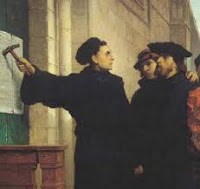
Do note, however, that this is not a "pie in the sky, by-and-by" sort of picture. Wearing Christ's righteousness will take us down paths that will not be easy. It will require us to take up our cross. That is the life of sanctification...following Jesus. Martin Luther's final two theses of the 95 say this:
94. Christians are to be exhorted that they be diligent in following Christ, their Head, through penalties, deaths, and hell;

95. And thus be confident of entering into heaven rather through many tribulations, than through the assurance of peace.
Notice the common language of Christ as our "Head" between Luther and Charles' lyrics above. But to return to the opening lyric of this verse, for those who walk in accordance with the Spirit (i.e., following Christ) there is no need to fear condemnation. It is not a matter of whether or not you recall a decision made in a point in time. It is a matter of whether or not you are walking with him now. Christ's cloth of righteousness will not stay on us if we don't move and follow him.

14 April 2011

And Can It Be? (v)

Update & disclaimer: when I posted what's written below, I was under the assumption that Charles Wesley wrote these lyrics with the remainder of the hymn. It has since been revealed to me, thanks to conversation with and investigation by Jonathan Powers, that this verse was not in Charles' composition but must have been added sometime later, which would explain its absence in most publications of the hymn. This verse is included on this page, which has a large compilation of hymns.

Verse 5
Still the small inward voice I hear,
That whispers all my sins forgiven;
Still the atoning blood is near,
That quenched the wrath of hostile Heaven.
I feel the life His wounds impart.
I feel the Saviour in my heart.

This is the only verse that does not appear in the United Methodist Hymnal. I've a hunch that the reasoning has to do with the fourth line and the language of "hostile Heaven." [Update: it also appears that Wesley didn't write this verse but this was added sometime later.] My friend Jonathan, who is a worship leader and has studied at length about Charles Wesley, said that he doesn't recall ever having heard or recited this verse in worship/song. He was aware of this verse, but was unable to recall the lyrics from memory like he is able to for the other verses of this hymn. We'll get to the more unsettled portion of this verse in a moment, but let's take the images of this stanza in order.

The first picture we have is the gentle voice of assurance that "all my sins [are] forgiven." Here the author combines the Scriptural imagery of Elijah's encounter with God on Mount Horeb in 1 Kings 19 with what appears to be an allusion to the witness of the Spirit ("inward voice"). Sometimes, like Elijah, we expect God to reveal himself in the grandiose (an earthquake, a fire, a thunderstorm), but what we get is a gentle whisper. It's not that forgiveness didn't come at a great and messy cost (the cross), for it did, but forgiveness is often instilled into our hearts gently and quietly. At the heart of the Lord's prayer is a prayer asking for forgiveness. Immediately prior, Jesus tells us to pray in secret. When my son breaks a rule in the house and we get to the point of confronting his wrong, he apologizes and I tell him, "I forgive you" while hugging him. I don't shout it. Forgiveness is whispered because it is told in the midst of embrace.

The atonement takes center stage in the third and fourth lines. Now, I understand the reasoning for omitting this verse because hostility implies a lack of control in today's usage of the term. It conjures up an image of unharnessed rage and destruction. I'm not sure what sort of reception this language of 'hostile Heaven' had in the days of when this verse was added, but what is clear is that the editor here is alluding to the theme of the atonement as propitiating the wrath/anger of God. To clarify, the Wesleys did not contend that wrath was an essential or eternal attribute of God, but was the passion/expression of his justice and its reaction to sin. John wrote in a letter:
Although, therefore, I do not term God, as Mr. [William] Law supposes, 'a wrathful Being,' which conveys a wrong idea; yet I firmly believe He was angry with all mankind, and that He was reconciled to them by the death of His Son. And I know He was angry with me till I believed in the Son of His love; and yet this is no impeachment to His mercy, that He is just as well as merciful.
(Note how love takes center stage and remains God's reigning attribute!) Matt O'Reilly posted recently on the issue of wrath and that we must see that wrath is not solely an expression about the Father's hatred of sin, but that wrath also exists in the other Persons of the Trinity. So, properly speaking, it is not as though the Father is placing His wrath on the Son against the Son's will, but that God is taking the wrath upon Godself (or absorbing it?) in the death of the God-human, Jesus. In that sense, it might be best understood, as Charles puts it in this hymn, that wrath is 'quenched.' The demands of holiness/justice are satisfied because of the sacrificial self-giving of the Son.

This nuance causes me to wonder about the reaction against the notion of God's wrath so prevalent in contemporary theological dialogue. Could it be that certain theologians are reacting more against the implications of a split Trinity (in which the image of a father inflicting his anger upon his son in rejecting him/turning away from him/etc.) than the notion of anger itself? Perhaps not, but maintaining the unity of purpose of the Persons of the Trinity in God's rescue plan that goes through the cross, would be one way of avoiding the pitfalls of many problematic expressions of penal substitutionary atonement. (Click here to see a line from John Wesley that shows the unity of purpose in the Godhead in redemption.)

The final two lines of this stanza return to the inner working of salvation by the editor's appeal to the feeling of new life that the presence of Christ brings when he enters into our hearts. Again we see the beauty of paradox in the picture that Christ's wounds heal us and give us life, an image found in Isaiah 53 and 1 Peter 2. Wounds that heal. 'Tis mystery all!

13 April 2011

And Can It Be? (iv)

Verse 4
Long my imprisoned spirit lay,
Fast bound in sin and nature's night;
Thine eye diffused a quickening ray--
I woke, the dungeon flamed with light;
My chains fell off, my heart was free,
I rose, went forth, and followed Thee.

This verse may well be the most beautiful combination of lyrics to illustrate sanctifying grace in all of poetry. To highlight sanctification in Wesleyan theological understanding, the picture of a prisoner in chains illustrates the bondage that sin keeps us in until Christ breaks the bond and sets us free from the power of sin. Whereas justification is oft described as the sinner's being set free from the guilt of sin, sanctification is being set free from sin's power. (There's really much more to the Wesleys' understanding of sanctification: for instance, John liked to use various phrases to describe it and preferred to speak about being made 'perfect in love' which conveys in part that TO which we are saved. But as it pertains to sin, i.e. what we are saved FROM, this is how it is best understood.)

For the Wesleys, prevenient grace is often imaged by the language of light. The passage to which John Wesley most frequently referred in speaking on prevenient grace was John 1.9: The light which enlightens everyone was coming into the world. Being in the midst of the prologue of St. John's Gospel, this clearly grounds the Wesleys' belief in prevenient grace upon the Person and work of Christ. So perhaps more accurately, we can say that this verse images the interchange of prevenient and sanctifying grace since even our response of rising, going forth, and following is enabled by the prior work of Christ. This clears the Wesleys from any false accusation of Pelagianism, whereby humans are capable of saving ourselves. From start to end, salvation is all grace.

To return to the picture of the prisoner in chains and its correspondence to sanctification, I recall on several occasions where Dr. Kenneth Collins made the following comment: "Forgiveness of sin without freedom from it is just polish for the chains that keep us bound." This is why salvation is so much more than being acquitted or being declared righteous. The angel told Joseph to name the child Jesus because he shall "save his people from (not in) their sin" (Matthew 1.21). In the theology of atonement, this imagery of a prisoner set free may have the closest affinity with the language of Christus Victor. It is a power-breaking grace that we are faced with. Christ breaks bonds that were impossible for us to break. If you recall in The Voyage of the Dawn Treader, Eustace (who had become a dragon) was unable to "undragon" himself. He was in bondage because of a bracelet around his wrist. Aslan (the Christ figure of the Chronicles of Narnia) had to peel off the dragon layers so that the bracelet could come off, and once that happened Eustace was able to go forth and follow the right path.

Where darkness, evil and death once reigned, Christ brings light, goodness, and life. He comes to break our chains so that we, like Charles confesses, can rise, go forth, and follow him!

12 April 2011

And Can It Be? (iii)

Verse 3
He left His Father's throne above
So free, so infinite His grace --

Emptied Himself of all but love,

And bled for Adam's helpless race:
'Tis mercy all, immense and free,
For O my God, it found out me!

Here we have Charles' beautiful lyrics of kenosis, Christ's humbling and self-emptying of himself. Many point to the Christ hymn of Philippians 2.5-11 (esp. verse 6 - "emptied") as the key Scriptural text for kenosis, although others read the passage through the lens of Christ as Second Adam. I don't see why both can't be at the heart of the passage. Kenotic theology maintains the full divinity of Christ though he suspended certain attributes from his conception to his ascension (see, for instance, Mark 13.32, which conveys that Jesus is unaware of when the final judgment would take place). To read Philippians 2 through the lens of Christ as Second Adam is to affirm his full humanity, his obedience in undoing the sin of Adam, which had 'grasped at equality with God' through disobedience. One of my favorite quotations comes from St. Irenaeus' On the Apostolic Preaching where he interprets the significance of the cross, and he seems to suggest the combination of these two themes:
And the transgression which occurred through the tree [of knowledge of good & evil] was undone by the obedience of the tree [the cross]--which [was shown when] the Son of Man, obeying God, was nailed to the tree, destroying the knowledge of evil, and introducing and providing the knowledge of good.
...of all but love. Again we see that love is God's reigning, his "darling attribute" as we saw in verse 1. Charles is obviously engaging in a bit of hyperbole, for he certainly didn't mean to imply that Christ let go of attributes such as justice, holiness, righteousness, and so forth. The point is that love (and we should couple mercy with it, seeing it at the heart of this verse) is the chief motivation of God's redemptive action in Christ. I say we should couple 'mercy' with love because the Wesleys saw them that way. In a letter to William Law, one of John's mentors, John stressed as much when he said that "love and anger [are] the passions (speaking after the manner of men) which correspond with the dispositions of mercy and justice." Mercy also belongs here because of what we find in the next line of the hymn: that we, Adam's race, were helpless. Christ bled and died to bring us to a helped state. It takes humility to recognize that the only way to life is to admit our own helplessness. It's no accident that it took Christ's humility to lift us out of helplessness.

I have the image of a lost sheep in my mind here. That is the image of helplessness. 'Tis mercy all! that Christ would enter into harm's way to find a stupid sheep like me, who brought this own helplessness upon myself. That mercy has found me! This was at the heart of the Wesleys' experience(s) and evangelical manifesto in 1738. Christ died for the world and is the savior of the world. They knew that! But they'd never personalized it the way St. Paul had in Galatians 2.20, where he affirms that Christ loved me and gave himself for me!

11 April 2011

And Can It Be? (ii)

Verse 2
'Tis mystery all: th'Immortal dies:
Who can explore His strange design?
In vain the firstborn seraph tries
To sound the depths of love divine.
'Tis mercy all! Let earth adore,
Let angel minds inquire no more.

I performed a search over at the Wesley Center Online to see if much had been written on this verse in particular. Nothing much showed up, but I found a series of sermons compiled into a book that were preached by P.F. Bresee. He quotes this verse in one of the sermons and writes some beautiful words that speak of this mystery that Charles Wesley was speaking to in this verse...that darkness and hope meet at the cross:
That is a marvelous utterance of the Spirit through the prophet Hosea -- "I will give her the valley of Achor for a door of hope." Achor was the dark place -- the place of disaster, defeat, wreck; and that place of darkness is made a door of hope. Where the wreck and ruin came, there the Cross is raised. Sin has caused the awful blight and curse, but right in the very place where the curse falls, there the Blood flows. The Lamb of God dies to take away the sin of the world.

The Son of God has made the darkest place of human history the most luminous place in this universe. Every thing is dim beside it. Ten thousand suns gathered into one, would be blackness itself compared to the unspeakable glory of the cross of Christ. The Cross is the great suffering, infinite, crowning glory of God. It is the mighty, struggling, dying effort to do what omnipotence can not do; to accomplish the impossible; to cause infinite justice and infinite mercy to kiss each other over the brow of a doomed man, and folding their arms about him, lift him to a new possibility. To the amazement of a moral universe it is done. Infinite love, infinite suffering bring it to pass.
'Tis mystery all! Moving into the lyrics themselves, in the last post, I suggested that Charles wasn't making an explicit theological statement about divinity dying. You might think that it would be best for me to back off from my assessment of Charles given his statement here, 'th'Immortal dies', but I still don't think he's making a doctrinal claim except the orthodox one that Christ is God (the Immortal one) from eternity (see Revelation 1.17-18). We saw similar claims from Charles in the series on the Nativity hymns we examined in December last year, which drew upon the rich paradox of God becoming Incarnate. The mystery and miracle of the Incarnation began in the Virgin womb and reaches a new height in the cross. But the story, as we know, was not over at Calvary. It couldn't be, but it had to go there.

Who can explore this strange design? For indeed, it is a mystery. As is true in many areas of theology (and life), when it comes to the death of Jesus, we must begin and end in the realization that we cannot exhaust its meaning. We cannot fully explore it. If we begin there, in worship and awe and humility, then we have the freedom to explain what is clear and admit what we ultimately do not and cannot know. The atoning death of Jesus is not a puzzle that needs to be pieced together. It is a mystery that we cannot ultimately explore in a way that we can explore the earth.

There's a funny clip in The Truman Show where Truman recounts his days in elementary school where he told his teacher that he wanted "to be an explorer, like the great Magellan!" His teacher (who had to take part in the ploy to keep Truman in the bubble created for his life) pulled down a map of the world and said: "Oh, you're too late! There's nothing left to explore." You and I are not made to wrap our heads around the atonement. It is bigger than our heads. If it weren't, then it wouldn't be much, would it? That's why there's something freeing about beginning with mystery and keeping that at the heart of Jesus' death, as Charles does here. In Psalm 31, John Wesley's notes convey the atonement as mystery when he says: ...the secret of God's tabernacle, as it is called, Psalm 27.5, the place of God's special presence, where none might enter save the high-priest. With thy secret favour and providence, which saves them by hidden and unknown methods.

Even angel minds cannot grasp the depths of love divine. Who are humans that You are mindful of us...that You care for us...that You'd become one of and die for us? It takes a good dose of humility and trust to adore something you cannot grasp, but that is what is asked of us when it comes to the death of Christ. But humility, trust, and adoration is truly freeing as we realize that the depths of the reality of God's love is beyond comprehension, yet we can truly experience it! 'Tis mercy all! Let earth adore...

09 April 2011

And Can It Be? (i)

Verse 1
And can it be that I should gain
An interest in the Saviour's blood?
Died He for me, who caused His pain-
For me, who Him to death pursued?
Amazing love! How can it be,
That Thou, my God, shouldst die for me?

So begins one of the theologically richest hymns ever written. Written by Charles Wesley, many say that if Methodism were to have a fight song this would unquestionably be it.

Thanks to Jonathan Powers' direction, I was taken to this article, which is a snippet about some of the background of Charles' writing the hymn. For instance, the hymn was first published under the title 'Free Grace,' which is interesting given that one of John Wesley's most famous sermons shares the same title (another reason to make this the fight song of Methodism). The lyrics, the author of the article notes, relates closely to Charles' special experience on May 21, 1738 (three days before his brother John's experience at Aldersgate where his heart was "strangely warmed"). Although rules of grammar are suspended to a certain degree when it comes to poetry, I am struck that this hymn begins with a coordinating conjunction: "And can it be...". I wondered if this meant that Charles originally had this hymn as a follow-up to a previous hymn or if it had some sort of poetical or theological significance. With no evidence that I've seen to the former, the latter seems most probable. Since Jonathan (mentioned above) is more of an expert on Charles and on hymnody in general, I asked him. He responded with this insightful thought: "By using 'And'+ it marks the song as a response/reflection on conversion." This strengthens the case that this hymn is deeply connected to the experience referenced above, an experience (similar to John's) that many call Charles' conversion.

The hymn begins with a coordinating conjunction because this hymn marks the response of someone who is in awe of the extent of God's love. Or, as the author of the article above put it, "The questions that open the hymn are a remarkable reiteration of the perplexion faced by one who is confronted by the wonder of God’s forgiving love...This mystery is at the heart of God’s love and mercy, which is inexplicable even to the angels. We are left simply to adore the depths of divine mercy."

This is that upon which this hymn is grounded. This is that upon which our salvation is founded: God's infinite, perplexing, and forgiving love! In Charles' journal on 14 August 1741, he records this:
I went after a stray sheep, who was turned out of the way by the predestinarians; but the good Shepherd had found her himself, and brought her home rejoicing. For some days she had been under the full influence of that narrow opinion, and could not bear any of her brethren and sisters. Then she cried unto the Lord to show her the truth, and he answered her by his own mouth. The true light broke in upon her, and in his light she saw that God is love. She is now humbled in the dust before him, for having "robbed him of his most darling attribute."
Notice that he says it is love that is God's "darling attribute." We'll see the theme of 'light breaking in' in another verse, so stay tuned for that. Interestingly, the topic of John's sermon 'Free Grace,' Charles' journal entry above, and John's treatise 'Predestination Calmly Considered' all center on the controverted issue of predestination and the Wesleys' disagreement with the Calvinists' take of the issue. But in all of these (and more), it is 'love' that is at the heart of God's nature and hence God's intent in saving fallen humanity. John, in 'Predestination Calmly Considered':
So ill do election and reprobation agree with the truth and sincerity of God! But do they not agree least of all with the scriptural account of his love and goodness? that attribute which God peculiarly claims, wherein he glories above all the rest. It is not written, “God is justice,” or “God is truth” (although he is just and true in all his ways). But it is written, “God is love,” love in the abstract, without bounds; and "there is no end of his goodness."
Two final points that probably deserve much more consideration. First, the lyrics 'gain an interest in the Saviour's blood' convey the metaphor of sin as debt and atonement as redemption (or perhaps ransom) with the language of commerce in gaining interest. This should not be read to suggest that 'ransom' or commercial atonement theology governs the Wesleys' (or at least Charles') approach to the atonement. Indeed, this hymn will go on to portray other themes that lay at the heart of Jesus' atoning death, but it does show that there is something immeasurable we gain in the death of Jesus. I think this is conveyed somewhat in 'How Deep the Father's Love for Us' by Stuart Townend in the lyrics:
Why should I gain from his reward?
I cannot give an answer.
But this I know with all my heart:
His death has paid my ransom.
Second (and finally), in relation to the recent posts about Tertullian's and Cyril of Alexandria's takes on the Godhead at the cross (you'll want to read the couple of comments on each post) comes the question of the final part of this verse: what did Charles import into "That Thou, my God, shouldst die for me?" Jonathan raised this question in the comments on the post about Tertullian. Though I could be mistaken as to Charles' meaning, I don't think he was making a theological argument to suggest that Christ's divinity died at the cross. If he was doing that, then I think he stood in opposition to the conclusions of the early church (most notably Cyril's theology, affirmed in the Council of Chalcedon). I rather think that Charles was using 'my God' as an expression much like Thomas cried in John 20.28. Charles rightly recognizes that Jesus is indeed "My Lord and my God!" It is an exclamation that, returning to an earlier point, shows our wonder at the infinite and perplexing breadth and depth of God's love, God's 'free grace'!

02 April 2011

Charles & 'The School of the Cross'


I've been reading through Charles Wesley: Life, Literature & Legacy, edited by Kenneth Newport and Ted Campbell. The book is very helpful as it presents Charles as a theologian in his own right and not to be seen solely through the lens of his older brother, John. This is demonstrated in the 28 chapters that come from the pens (or keyboards, I suppose we should say) of more than 25 Wesley scholars who write on the various theological, historical, and personal aspects of Charles' life. One chapter that stands out in particular to me, as a student of atonement theology, is the one brought forth from John R. Tyson, "'I preached at the Cross, as usual': Charles Wesley and Redemption".

I won't regurgitate everything spelled out by Tyson here, but I did want to draw attention to a helpful insight that seems appropriate to draw out in the Lenten season and that is his a section where Tyson talks about the school of the cross. This is not something about academia, but he's drawing upon language from Charles that speaks about the Christian's life as learning the way of the cross. Tyson begins, "For Charles Wesley the cross was not only God's decisive act in the history of redemption, it became the pattern for the Christian's life as well." He adds, "By observing and participating in Christ's sufferings, Christians come to 'know him,' they begin to partake of his Spirit, and are thereby prepared for their own victory over death and for the life to come." This is demonstrated in Charles' lyrics. For instance:

We now who Jesus' spirit breathe
The ills of life with patience bear,
With joy receive the stroke of death,
With faith expect his rise to share,
His victory o'er the gaping tomb,
And live His endless life to come.

and...

While I thus my Pattern view,
I shall bleed and suffer too,
With the man of sorrows join'd
One become in heart and mind.

More and more like Jesus grow,
Till the Finisher I know,
Gain the final Victor's wreath,
Perfect love in perfect death.

and further still...

Thy suffering, Lord, doth mine imply
And binds me on thy cross to die.

The term 'Pattern' above should stand out as an indicator of an important influence upon the Wesleys: The Christian Pattern, (or The Imitation of Christ) from Thomas a Kempis, a work that John extracted and published for his English readers. This hardly exhausts the Wesleys' approach to redemption, but it does draw out an important facet of the cross that is often lacking in many presentations today of the Atonement and its implications: that in Jesus' speaking of his own impending path toward the cross, he bids his disciples/students to 'take up your cross' and follow him. This prepares us, as Tyson suggests, for our own "victory over death."

Jon Foreman, in his Winter EP, has somewhat portrayed this notion of the 'school of the cross' in the lyrics of 'Learning how to Die' when he speaks of realizing that life is not about taking, accessing, laughing, but about learning how to give, cry, and die. A most appropriate song for Lent:

17 January 2011

Psalm 10

1 Why standest thou afar off, O LORD?
Why hidest thou thyself in times of trouble?

2 The wicked in his pride doth persecute the poor;
let them be taken in the devices that they have imagined.
3 For the wicked boasteth of his heart's desire,
and blesseth the covetous, whom the LORD abhorreth.
4 The wicked, through the pride of his countenance, will not seek after God;
God is not in all his thoughts.
5 His ways are always grievous;
thy judgments are far above out of his sight;
as for all his enemies, he puffeth at them.

6 He hath said in his heart, "I shall not be moved,
for I shall never be in adversity."
7 His mouth is full of cursing and deceit and fraud;
under his tongue is mischief and vanity.
8 He sitteth in the lurking places of the villages;
in the secret places doth he murder the innocent;
his eyes are privily set against the poor.
9 He lieth in wait secretly as a lion in his den;
he lieth in wait to catch the poor;
he doth catch the poor, when he draweth him into his net.
10 He croucheth, and humbleth himself,
that the poor may fall by his strong ones.
11 He hath said in his heart, "God hath forgotten;
he hideth his face, he will never see it."

12 Arise, O LORD; O God, lift up thine hand;
forget not the humble.
13 Wherefore doth the wicked contemn God?
He hath said in his heart, "Thou wilt not require it."
14 Thou hast seen it; for thou beholdest mischief and spite, to requite it with thy hand;
the poor committeth himself unto thee;
thou art the helper of the fatherless.
15 Break thou the arm of the wicked and the evil man;
seek out his wickedness till thou find none.

16 The LORD is King for ever and ever;
the heathen are perished out of his land.
17 LORD, thou hast heard the desire of the humble;
thou wilt prepare their heart, thou wilt cause cause thine ear to hear
18 To judge the fatherless and the oppressed,
that the man of the earth may no more oppress.

JW: David complains of and describes the wicked, ver. 1-15; prays to God to appear against them, and rejoices in the prospect of it, ver. 12-18.

[On verse 5:] 'Ar far' - He doth not regard or fear them; yea he despises them, being confident that he can blow them away with a breath. This is a gesture of contempt or disdain, both in scripture and other authors.

[On verse 7:] 'Tongue' - Under his fair and plausible speeches, mischief is hid and covered. 'Vanity' - or injury, the vexation or oppression of other men.

[On verse 10:] 'Croucheth' - like a lion which lies close upon the ground, partly that he may not be discovered, and partly that he may more suddenly and surely lay hold on his prey.

[On verse 13:] 'Contemn' - Why dost thou by giving them impunity, suffer and occasion them to despise thee?

[On verse 14:] 'Requite' - Heb. to give (to restore or pay the mischief which they have done to others) with thy hand, by thy own extraordinary providence, because the oppressed were destitute of all other succours. 'Fatherless' - of such as have no friend or helper, one kind of them being put for all.

[On verse 16:] 'Is King' - To whom it belongs to protect his subjects. Therefore his peoples case is never desperate, seeing he ever lives to help them.

[On verse 18:] 'To judge' - to give sentence for them, and against their enemies. 'The man' - earthly and mortal men, who yet presume to contend with thee their maker.

Where are the songs today that defend the cause of the poor? That take up the case for the fatherless? That cry for the justice of God to excise the wickedness that enslaves the oppressed? Jonathan Powers started this conversation on his blog a few months ago in this post, which includes some powerful lyrics by Charles Wesley about defending the cause of the poor.

What strikes me in this psalm is the discernment and awareness of the psalmist to the schemes of the enemy whose intent is to oppress, rob, and kill. We lack that precision of discernment today: we're either too quick to condemn something as evil that really isn't or we're too naive about the intents of 'the world.' If you give me the choice of being judgmental or naive, I think erring on the side of naivety is perhaps best because in the end God will bring justice in setting free those who have been enslaved and taken advantage of. Still, this psalmist has a keen eye toward the enemy's ploys. Maybe she had been robbed in the outskirts of town. Maybe her naivety was exploited by someone. That seems reasonable. So she cries for God to bring justice to this evil.

The ploy that stands out most to me at this point is what is said in verse 10. The King James Version (as above) notes that the enemy "humbleth" himself. That seems odd, doesn't it? Everything in the Bible I am aware of that speaks of humility is a positive thing that leads to goodness and holiness. But here the enemy is only appearing to be humble. That is dangerous! Very dangerous! What appeals to us more than a picture of innocence? Most English translations of the Bible use the word crafty or something similar to describe the serpent in Genesis 3.1. But did you know the Hebrew word there is the same as what is rendered naked in Gen. 2.25? (Hat tip to Lawson Stone from OT Intro on that point.) Eden pre-fall is the common picture for 'innocence' & the enemy uses this to its advantage. I'm not suggesting we look for a demon under every bush, but being aware of the abuse of the appearance of innocence will be key in practicing discernment in a world that is easily enslaved to and enslaves us to the enemy.

We have a somewhat violent image in verse 15, which calls upon God to "break the arm" of the wicked and evil. It's a metaphor, for "arm" symbolizes strength. Break the source of the strength that enslaves the poor, oppressed, and fatherless, God! Disarm the enemy! It is because of verses like these that I think that Christus Victor atonement speaks so strongly to an oppressed, enslaved, seemingly hopeless people. The cry for justice here is not just a pleading that God would find the oppressors guilty, but that God would actually set the oppressed free from their bondage. That's why it's important to speak not only of being set free from condemnation & guilt but also from sin's grip. (Think justification & sanctification. More importantly, allow God to make these realities in our lives.) Break the power!

06 January 2011

Psalm 2

1 Why do the heathen rage,
and the people imagine a vain thing?
2 The kings of the earth set themselves,
and the rulers take counsel together,
against the LORD, and against his anointed, saying,
3 "Let us break their bands asunder,
and cast away their cords from us."

4 He that sitteth in the heavens shall laugh;
the LORD shall have them in derision.
5 Then he shall speak unto them in his wrath,
and vex them in his sore displeasure, [saying,]
6 "Yet I have set my king
upon my holy hill of Zion."

7 I will declare the decree:
the LORD hath said unto me, "Thou art my Son;
This day I have begotten thee.
8 Ask of me, and I shall give thee the heathen
for thine inheritance,
and the uttermost parts of the earth
for thy possession.
9 Thou shalt break them with a rod of iron;
thou shalt dash them in pieces like a potter's vessel.

10 Be wise now therefore, O ye kings;
be instructed, ye judges of the earth.
11 Serve the LORD with fear,
and rejoice with trembling.
12 Kiss the Son,
lest he be angry, and you perish from the way,
when his wrath is kindled but a little.
Blessed are all they that put their trust in him.

JW: There is nothing in this psalm which is not applicable to Christ, but some things which are not all applicable to David. Threatenings denounced against the adversaries of Christ's kingdom, ver. 1-6; Promises made to Christ, ver. 7-9; Counsel given to all, to submit to him, ver. 10-12.

[On verse 7:] 'My Son'- which tho' it may in some sort be said to, or of David, yet much more properly belongs to Christ, who is commonly known by this title both in the Old and New Testament, and to whom this title is expressly appropriated by the Holy Ghost, who is the best interpreter of his own words, Acts 13.33, Heb. 1.5. 'This day' - This may be understood either, Of his eternal generation. This day, from all eternity, which is well described by 'this day,' because in eternity there is no succession, no [yesterday], no [tomorrow], but it is all as one continued day or moment without change or flux; or, Of the manifestation of Christ's eternal son-ship in time; which was done both in his birth and life, when his being the son of God was demonstrated by the testimony of the angel, Luke 1.32, and of God the Father, Matt. 3.17; 17.5, and by his own words and works; and in his resurrection, which seems to be here mainly intended, of which day this very place is expounded, Acts 13.33.

[On verses 10-11:] 'Now' - while you have time for repentance and submission. 'Fear' - With an awful sense of his great and glorious majesty. 'Rejoice' - do not esteem his yoke your dishonour and grievance; but rejoice in this inestimable grace and benefit. 'Trembling' - This is added to warn them of taking heed that they do not turn this grace of God into wantonness.

Though this Psalm is referenced in Acts 13.33, as Wesley notes, the context of which is about Christ's resurrection, I still find it providential that this Psalm is in view on Epiphany, which I posted on earlier today. Epiphany, as was said then, has to do with the revelation of Jesus as the Christ and God's Son. This is made very public in Jesus' baptism when the voice came from heaven saying, "This is my beloved Son, in whom I am well pleased."

Notice this: Christ heard these words at his baptism. Immediately following his baptism, Jesus, as we know, went into the wilderness and was tempted by the devil. Does one of the temptations sound familiar to the next line in this psalm? "Ask of me, and I will make the nations your heritage." Remember how the devil tempted Jesus with bestowing authority over the whole world? (See Matt. 3.8-9; Luke 4.5-7.) And it is precisely Christ's Son-ship that Satan is trying to attack as it tempts Him. Jesus knew who had the ultimate authority and who was speaking to him. He knew his Father's voice. We would do well to be acquainted with the Shepherd's voice.

I appreciate Wesley's Christological take on this Psalm. His approach stays true to his introduction to the Psalter, and stays true to the tradition of the Church to read Scripture through the lens of Christ.

One final note on this Psalm: I'm intrigued by the language of verse 3 - "Let us break their bands asunder..." Maybe I'm reading too much into this or maybe I've just got some of Charles Wesley's lyrics from the Nativity on my mind, but I am curious if Charles was using the language of the rulers who conspire against the Anointed and turns the words on their head to show that it is the Anointed who will be the One to "break bands" asunder. Hymn VI of the Nativity collection, which I blogged on last month, has this lyric: "Those Infant-hands shall burst our bands and work out our salvation."