Showing posts with label John Wesley. Show all posts

14 July 2011

A Wesleyan Appropriation of the Cry of Dereliction - Part 4

In concluding this series on exploring a Wesleyan interpretation of the cry of dereliction, we will pick up where we left off the last post, which appealed to Wesley's belief of Christ's human will as submissive to the will of God. This, in my view, leads naturally to what I see as the richest pastoral payoff for this passage.

It is worthy to note that in the sermon The Repentance of Believers, cited in the previous post, Wesley’s exhortation was that our will would be less self-directed and more in submission to the will of God. That is, Christ’s human will in subjection to the will of God is the image of our sanctification...what it looks like for someone who expresses his or her trust in God, even when God seems to be hiding or distant. I think we see this in Wesley’s interpretation on the beatitude, ‘Blessed are they that mourn, for they shall be comforted':
But he now ‘hides his face, and they are troubled:’ They cannot see him through the dark cloud. But they see temptation and sin, which they fondly supposed were gone never to return, arising again, following after them again, and holding them in on every side. It is not strange if their soul is now disquieted within them, and trouble and heaviness take hold upon them...Blessed are they who…steadily refuse all other comfort. They shall be comforted by the consolations of his Spirit.
Whether or not Wesley really had this connection of Christ and our sanctification in mind, I am unsure. But I cannot but draw this conclusion. The battle against sin and temptation is clearly in view, and by submitting to the will of the Father and only seek consolation through the Spirit, even when we ‘cannot see God,’ we move forward to victory in sanctification, just as Christ continued to pour out his heart to his Father even through death. 'Blessed is the one who steadily refuses all other comfort...' Sound like Christ on the cross? The Roman centurion even noticed that there was no enmity between the man who died on the cross and God, but even declared him as God's Son! The will that is submitted to God is not afraid to mourn or scream at injustice. It may just be the sign of someone who is more in tune with God (read: sanctification) than most everyone else. In this light, we might be well on our way toward a Wesleyan appropriation of the cry of dereliction and sing with John and his brother Charles Wesley, who once wrote,
O Jesu, let thy dying cry
Pierce to the bottom of my heart,
Its evil cure, its wants supply,
And bid my unbelief depart.

13 July 2011

A Wesleyan Appropriation of the Cry of Dereliction - Part 3

In continuing the exploration of a Wesleyan interpretation of Jesus' cry of dereliction ("My God, my God, why have you forsaken me?"), the last post centered on the Trinitarian question as we noted the vital importance of maintaining a unity in the essence and purpose among the Persons of the Godhead. Seeing that the Son and the Father, together with the Spirit, are eternally of the same substance, we see that any suggestion of a split or separation of the Godhead at any point brings disastrous implications. In this post, we will see what, if any, insights of the doctrine of Christ's two natures (fully divine, fully human) can provide for the question of Christ's desperate cry.

Several early church fathers suggested that the cry is according to the flesh or according to his humanity. For the sake of space, we will appeal only to St. Ambrose, who in, The Sacrament of the Incarnation of Our Lord, wrote:
According to the flesh, He was forsaken, who according to divinity could have been neither deserted nor forsaken…These words [‘Why hast thou forsaken me’] are said according to the flesh, which are very foreign to the fullness of His divinity, for the words of sins are foreign to God, since the sins of words are also foreign to Him; but since I [Christ] have assumed the sins of others, I have assumed also the words of others’ sins, so that I say that I, who am always with God, have been forsaken by God the Father.
In his, On the Christian Faith, St. Ambrose offered another note on the passage that might clarify the issue further, especially in referring to the dereliction as a perceived abandonment:
Finally, He cried: “My God, My God, why hast Thou forsaken Me?” As being man, therefore, He speaks, bearing with Him my terrors, for when we are in the midst of dangers we think ourself abandoned by God. As man, therefore, He is distressed, as man He weeps, as man He is crucified.
One might think that this borders too closely to, if it doesn’t cross over into, Nestorianism, which divided the two natures to such a degree that there is no unified person, but two persons. In avoiding this error, it is worthy to note, firstly, that St. Ambrose wrote prior to the Nestorian controversy. Even so, he did not separate Christ into two persons, but instead affirms Christ's assumption of humanity. What we humans experience, God has assumed in the Person of the God-human.

Secondly, it could be that the cry of dereliction is an example that highlights that there were two wills in Christ, just as there are two natures. Accordingly, Jesus' cry from the cross might be seen in comparison with his earnest pleading in the Garden of Gethsemane, perhaps the most well-known passage that appeals to the two wills in Christ, when he prayed for the cup to pass from him, "nevertheless, not my will but yours be done."

And in this case, there is evidence of Wesley’s support of Christ’s two wills. In The Repentance in Believers, John Wesley stated the following:
[A will] is an essential part of human nature, indeed of the nature of every intelligent being. Our blessed Lord himself had a will as a man; otherwise he had not been a man. But his human will was invariably subject to the will of his Father.
I realize that much of what I've said and appealed to may be rather complicated and perhaps is attempting to address something beyond our capacity to understand. It is not my interest to explore this question merely as an academic or intellectual exercise. I really believe this theological unpacking has a significant pastoral payoff, and I intend to tease out at least one significant conclusion, a distinctively Wesleyan one that will pick up on this last quote from Wesley, in the next and final post in this series. If you're still with me, thanks for following and I look forward to any criticism or questions you may have.

12 July 2011

A Wesleyan Appropriation of the Cry of Dereliction - Part 2


In the last post, I introduced a series that would begin to explore a Wesleyan interpretation of Jesus' cry of dereliction, "My God, my God, why have you forsaken me?" I concluded the post by saying that it is reasonable to suggest that John Wesley held that whatever is meant by God's hiding his face from Jesus, it should be read analogically. Even if Wesley did not explicitly make this statement, I think this conclusion is the only way to avoid a tragedy of creating a rift within the Holy Trinity. This short post will draw attention to the unity of the Godhead in saving the world. This, according to Wesley, is the ground of our redemption, which has its apex at the cross of Christ.

Whatever else might be implied by Wesley’s definition of ‘forsaken’ and his comments on the Father’s face being hidden, on no occasion does Wesley suggest that there is ever (even on the cross) any animosity between the Persons of the Godhead. The movement of redemption is not solely the work of the Son of God. Wesley suggests that all Persons in the Trinity are at work in redemption in a letter to William Law. In a section of the letter that he borrowed from Anna Maria Van Schurman’s journal, he quotes her as saying:
The origin and cause of our redemption is the ineffable love of God the Father, who willed to redeem us by the blood of His own Son; the grace of the Son, who freely took our curse upon Him, and imparts His blessing and merits to us; and the Holy Spirit, who communicates the love of the Father and the grace of the Son to our hearts.
Readers of my blog may have seen this quote posted before, which I did here. In addition to this unity of a redeeming purpose, Wesley also advocated, in orthodox fashion, the unity of essence among the divine Persons, and makes this especially known in his strong defense of the full divinity of Christ. Christ is of the same essence as the Father and the Spirit. If there is any "split" or "separation" in the Godhead at the cross, then this is unquestionably advocating polytheism.

I've posted before on drawing wisdom from the Fathers of the Church on this matter, but I think the thoughts from Saints Athanasius and Chrysostom on the cry of dereliction are worth repeating. St. Athanasius:
For behold when He says, "Why hast Thou forsaken Me?" the Father shewed that He was ever and even then in Him; for the earth knowing its Lord who spoke, straightway trembled, and the vail was rent...then seeing these signs, [the centurion] confessed that "truly He was the Son of God."
And St. Chrysostom:
That darkness [at the cross] was a token of the Father's anger at their [the crowd's] crime...He saith, "Eli, Eli, lima sabachthani?" that unto His last breath they might see that He honors His Father, and is no adversary of God...and by all things, He shows how He is of one mind with Him that begat Him.
If we suggest, in the fashion of Wesley, that in Jesus' death, the wrath of God was assuaged or propitiated (an issue that needs to be addressed, but is too much for this post), we must not read this so strictly that it breaks the bond and unity of essence among the divine Persons. Otherwise, we'd have one god saving us from another.

Seeing the significance of maintaining the unity of essence and purpose between the Father, the Son, and the Spirit, we will next address how the doctrine of Christ's two natures may speak to the issue of Jesus' dereliction cry.

07 July 2011

A Wesleyan Appropriation of the Cry of Dereliction - Part 1

I apologize for the sparse posting of recent: I spent much of June preparing for a paper I presented at a colloquium in Manchester, from which I have shared a brief piece with you in the last post on impassibility. In the next few posts, I want to share some of the conclusions I have come to in regards to exploring a Wesleyan appropriation of Jesus' cry of dereliction at the cross ("My God, my God, why have you forsaken me?").

As you can read on this post, I have written bits and pieces on this issue, but in the next posts I will be sharing how this issue developed into the paper I presented. The paper was much more lengthy than what I'm going to share, so I'll cut right to the chase on the issues I see at stake.

When it comes to addressing the question of the significance of Jesus' cry from the cross, it is vital to turn to Psalm 22, seeing that Jesus was quoting that Psalm. John Wesley
's introduction to his notes on Psalm 22 made it clear that he read the Psalm through the lens of Christ in saying that it was:


…directly, and immediately intended for, and [was] properly to be understood of the Messiah…[and was held to be so] by the Hebrew doctors themselves, and by Christ himself and by his apostles. And there are many passages in it, which were literally accomplished in him, and cannot be understood of any other. In this psalm David speaks of the humiliation of Christ, ver. 1 - 21. Of the exaltation of Christ, ver. 22 - 31.


Many of Wesley’s notes throughout the Psalm are valuable for ascribing different verses therein directly to Christ on the cross. Potential difficulty arises, however, when we view Wesley's comments on the meaning of ‘forsaken'ness (v. 1) as applied to Christ as well as Wesley’s clarifying comment on the affirmation that God had not hid his face from the psalmist/Christ (v. 24), which is where we will direct our attention in this post.

On the word ‘forsaken’ Wesley interprets it as though Christ is saying: ‘[My God, Why have you] withdrawn the light of thy countenance, the supports and comforts of thy spirit, and filled me with the terrors of thy wrath’ and then adds in commenting that ‘this was in part verified in David, but much more fully in Christ.’ In verse 24, the psalmist says, ‘For he hath not despised nor abhorred the affliction of the poor: neither hath he hid his face from him, but when he called unto him, he heard.’ Wesley qualifies this significantly in taking ‘[neither hath he hid his face] from him’ to mean ‘for ever: tho’ he did so for a time.’ Said otherwise, according to Wesley, God hid his face from Jesus for a short time, though he does not specify if this was only a brief moment on the cross, for the duration of the crucifixion, or perhaps even from his praying in the Garden of Gethsemane. On Luke 22:44, in the midst of the passage of Jesus' praying in the Garden, Wesley noted that Jesus was ‘Probably just now grappling with the powers of darkness: feeling the weight of the wrath of God.’ That he began to feel God’s wrath even then might suggest that, according to Wesley, God’s face might have been hid from this moment. Wesley’s note on Jesus’ cry in Matthew’s gospel (27:46) does not clear this up but conveys, similarly,
Our Lord hereby at once expresses his trust in God, and a most distressing sense of his letting loose the powers of darkness upon him, withdrawing the comfortable discoveries of his presence, and filling his soul with a terrible sense of the wrath due to the sins which he was bearing.
It is clear that, for Wesley, God’s wrath is intricately linked with whatever is meant by God’s hiding his face from Christ. Although Wesley does not go so far as to say there was an actual separation or a split in the Godhead, which is the conclusion some are unafraid to explicitly embrace, the implications of this idea upon the doctrine of the Trinity are potentially disastrous. The thing that may rescue Wesley from committing a grievous error in rending apart the Persons of the Trinity might be in his comment on the first part of verse 24, when he clarifies that God had not ‘abhorred…’ in saying, ‘He did not turn away his face from it, as men do from things which they abhor.’ Wesley, it seems, interpreted at least this part metaphorically in that we should not equivocate human actions or emotions with those of God. Perhaps this is related to what Wesley said in his notes on Romans 5:9 on the nature of God’s wrath:

Wrath in man, and so love in man, is a human passion. But wrath in God is not a human passion; nor is love, as it is in God. Therefore the inspired writers ascribe both the one and the other to God only in an analogical sense.


If he saw the first part of Psalm 22:24 as analogical, then it is reasonable, though by no means definitive, to suggest that Wesley read the latter part, of God hiding his face from Jesus, analogically also.

In the remaining posts of this series, we'll look at the issue of Jesus' abandonment, whether it was real or perceived, look to a few Patristic sources as well as some more interaction with Wesley in relation to that question.

26 May 2011

Sparse posting...working on a project...

I apologize for the sparse posting as of recent. My publishing energies at this point are focusing on a paper presentation I'm working on for the MWRC Colloquium in mid-June, where my topic is on Christology and the death of Jesus in Wesleyan theology. In particular, I'm focusing on the interpretation of Jesus' cry of dereliction ("My God, my God, why have you forsaken me?"). I've posted a few times on Jesus' cry and its relation to Psalm 22. Here are the posts related to the topic:

To give you a little foretaste of where I think I'm heading... it appears to me that when certain theologians have made problematic conclusions of the implications of this passage (e.g., that there is a split or separation in the Trinity, at least between the Father and the Son), it is because they have immediately taken the passage to the doctrine of the Trinity rather than first addressing the doctrine of Christ's two natures. Once we determine exactly what the cry means and where it is coming from within Jesus, then it is appropriate to raise any Trinitarian questions, but not until then (in my opinion). There appears to be unanimity from the interpreters of the early centuries that when Jesus makes this cry it is from his human nature. There are other significant implications of the passage that early luminaries have drawn out that are related to this insight, but I'll save those for later. As for Wesley's take himself, he doesn't explicitly draw this conclusion (and as I have posted before, he draws conclusions that I find problematic), but I think that several statements he makes elsewhere and his Christology in general finds congruence with the interpretation of the early centuries.

After I finish the paper, I'll share some of the conclusions I'll have drawn as well as some questions that remain unanswered.

09 May 2011

"...till the time of his trial should be ended." (?)

Seeking your assistance here. I'm reading John's sermon, 'Justification by Faith' and came upon something I hadn't noticed before. This statement is early in the sermon, where he is establishing the general ground for the doctrine of justification by faith. He begins, appropriately, in the creation, but he includes this phrase that I'm not altogether sure what he implies. It's the part in bold below (and also shown in the title of this entry).
To man thus upright and perfect, God gave a perfect law, to which he required full and perfect obedience. He required full obedience in every point, and this to be performed without any intermission, from the moment man became a living soul, till the time of his trial should be ended. No allowance was made for any falling short: As indeed, there was no need of any; man being altogether equal to the task assigned, and thoroughly furnished for every good word and work.
What do you think he meant by this? Did Wesley have a supposition of how history might have panned out differently had Adam & Even remained obedient? I'm aware that theologians in the Orthodox Church (from St. Irenaeus) maintain that even had 'The Fall' not happened, that the Word still would have been made flesh. There is a clarification to be made here in what is meant by 'perfect': i.e., just how 'perfect' were our first parents created? St. Irenaeus speaks of Adam & Eve as innocent, though he calls them infants/children. This infers that humans were created with 'room for growth,' as it were. This view, the way I understand it at this point, maintains that Adam & Eve were created 'good' but not 'perfect,' at least not in the absolutist sense. Hence, the goal would be that humans would grow and that the Incarnation would perfect the humanity, uniting us to the Triune God in a way that our first parents were not (originally, anyway). It is the progression from the "external" to the "internal".

One might read such into Wesley's phrase above, but in his multiple declarations of the felix culpa tradition where he speaks of 'the fall' as the "happy fault," Wesley says that had it not been for the original sin, then we would not have known Christ because sin was the very grounds for and necessitated the Incarnation (see sermons 'On the Fall of Man' and 'God's Love to Fallen Man'). Furthermore, he says that in the wake of the Incarnation that humans can now enjoy higher degrees of happiness and holiness than humanity prior to the fall. This idea seems to be derived scripturally from Romans 5.20: "But where sin increased, grace increased all the more." So in a sense, they argue for a similar conclusion (that humanity in Christ enjoys something of a higher degree than our first parents) but take very different avenues to get there (St. Irenaeus: this was part of the plan even before the sin; felix culpa tradition: it is because of the sin that this is possible). So if Wesley falls in this latter camp, then I return to the question: what does he mean by this phrase "...till the time of his trial should be ended"?

04 May 2011

Psalm 34

A psalm of David, when he changed his behaviour before Abimelech: who drove him away, and he departed.

1
I will bless the LORD at all times: his praise shall continually be in my mouth.

2My soul shall make her boast in the LORD: the humble shall hear thereof, and be glad.

3O magnify the LORD with me, and let us exalt his name together.

4I sought the LORD, and he heard me, and delivered me from all my fears.

5They looked unto him, and were lightened: and their faces were not ashamed.

6This poor man cried, and the LORD heard him, and saved him out of all his troubles.

7The angel of the LORD encampeth round about them that fear him, and delivereth them.

8O taste and see that the LORD is good: blessed is the man that trusteth in him.

9O fear the LORD, ye his saints: for there is no want to them that fear him.

10The young lions do lack, and suffer hunger: but they that seek the LORD shall not want any good thing.

11Come, ye children, hearken unto me: I will teach you the fear of the LORD.

12What man is he that desireth life, and loveth many days, that he may see good?

13Keep thy tongue from evil, and thy lips from speaking guile.

14Depart from evil, and do good; seek peace, and pursue it.

15The eyes of the LORD are upon the righteous, and his ears are open unto their cry.

16The face of the LORD is against them that do evil, to cut off the remembrance of them from the earth.

17The righteous cry, and the LORD heareth, and delivereth them out of all their troubles.

18The LORD is nigh unto them that are of a broken heart; and saveth such as be of a contrite spirit.

19Many are the afflictions of the righteous: but the LORD delivereth him out of them all.

20He keepeth all his bones: not one of them is broken.

21Evil shall slay the wicked: and they that hate the righteous shall be desolate.

22The LORD redeemeth the soul of his servants: and none of them that trust in him shall be desolate.

JW: David praises God for his goodness to himself and others, ver. 1 - 7; encourages the righteous to trust in him, ver. 8 - 10; exhorts them to fear God and depart from evil, ver. 11 - 14; God's favour to the righteous and displeasure at the wicked, ver. 15 - 22.

Title of the psalm. When - A psalm made upon that occasion, though not at that time, when he counterfeited madness. Wherein whether he sinned or not, is matter of dispute; but this is undoubted, that his deliverance deserved this solemn acknowledgment. Abimelech - Called Achish, 1Sam 21:10. But Abimelech seems to have been the common name of the kings of the Philistines, Gen 20:2 26:1, as Pharaoh was of the Egyptians.

3: 'Together' - Not in place, for David was no banished from the place of God's public worship, but in affection; let our souls meet, and let our praises meet in the ears of the all-hearing God.

5: 'Lightened' - Comforted and encouraged. 'Ashamed' - They were not disappointed of their hope.

8: 'O taste' - Make trial, of it by your own experience of it. 'Good' - Merciful and gracious.

9: 'Fear' - Reverence, serve, and trust him; for fear is commonly put for all the parts of God's worship.

14: 'Depart' - From all sin. 'Do good' - Be ready to perform all good offices to all men. 'Seek' - Study by all means possible to live peaceable with all men. 'Pursue it' - Do not only embrace it gladly when it is offered, but follow hard after it when it seems to flee away from thee.

16: 'The face' - His anger, which discovers itself in the face.

18: 'Nigh' - Ready to hear and succour them. 'To' - Those whose spirits are truly humbled under the hand of God, and the sense of their sins, whose hearts are subdued, and made obedient to God's will and submissive to his providence.

What a majestic psalm for the age and season of the resurrection! It is a psalm of hope for it looks to God's deliverance from affliction and trouble (which really came through affliction and trouble: think crucifixion/death) for those who put their trust in him and gives us hope for the future. They were not disappointed of their hope.

The command is to 'Depart!!' from evil, from all sin. This is why I came to verse 4 of 'And Can It Be?' when I thought of the resurrection and its sin-breaking, death-breaking power for us today and tomorrow! From the dark dungeon of death, God's face, God's eye diffused a quickening ray of light that bids 'Come awake!' and 'The grave no longer has a hold on you!' Jesus spoke of another 'Depart!' in the final judgment, but if we hear the 'Depart!' of this psalm, then we are in good company and we have hope. My chains fell off! My heart was free! I rose, went forth, and followed Thee!

But to what do we depart? That's why this psalm is so beautiful for it captures not only that from which we are saved but also that to which we are saved & sent: exalting, seeking, trusting and worshiping God! Doing good, seeking peace and pursuing it! It is, in short, what verse 12 describes as desiring life! From death to life! Praise be unto Father, Son, and Holy Spirit, for 'the Spirit of him that raised up Jesus from the dead dwells in you.'

02 May 2011

Unlikely Places

It is well known that John Wesley had an experience in which he found his heart "strangely warmed" in the evening of May 24, 1738 in a simple building on Aldersgate Street in London. Less well known is that earlier in the day Wesley attended St. Paul's Cathedral, whose beauty and grandeur you can see on a very minuscule scale here. (Do a Google Image search for "St. Paul's Cathedral, London" to see other views.)

I've made reference in a couple of posts to the late Reginald Mallett. I've been reading a collection of his sermons delivered at Lake Junaluska. Dr. Mallett elaborated on this historic day in Wesley's life in a sermon based upon the text of Acts 19.9-10, where St. Paul taught, argued, and preached for two years in the lecture hall of Tyrannus. There are times where the spirit of the age looks for God in certain places...places of grandeur and awe. Dr. Mallett writes:

The spirit of the age would say that John Wesley ought to have had his life-changing experience in St. Paul's Cathedral when he was there on May 24, 1738. The awesome masterpiece by Sir Christopher Wren was surely an appropriate setting for such a historic spiritual encounter. The Holy Spirit thought otherwise. That very evening in a simple room on Aldersgate Street, a work of grace occurred which caused the restless Anglican clergyman to feel his heart strangely warmed. In such an unlikely place, a fire began to burn in Wesley's life that set England and the world aglow.

To be sure, we cannot ignore the path that led Wesley to Aldersgate Street that evening; a path that included his visitation to St. Paul's Cathedral earlier in the day, where the anthem was from Psalm 130: "Out of the deep I have called unto Thee, O Lord - O Israel, trust in the Lord, for with the Lord there is mercy, and with Him is plenteous redemption, and He shall redeem Israel from all her sins." But Dr. Mallett is onto something in noting that God often reveals himself in the most unlikely of places and circumstances: Bethlehem, Nazareth, Calvary, walking on a road (Emmaus), a lecture hall, a small room.

I can resonate here. Some of the more special experiences in my life have come in places that the world would consider mundane: in the utility room (conversing with my parents on confessing my faith in Christ), driving down the road (listening to Smalltown Poet's rendition of 'Only Trust Him,' the hymn playing upon my public confession of faith to the church), sitting on a stump outside of a muddy cave (conversing for the first time with who would one day become my wife). There were certainly other encounters in perhaps more sublime circumstances that led to those experiences, but there is something profound, it seems to me, in the experience of God's grace in the everyday occurrences of life, grace of which we tend to be unaware.

Where has this rung true in your life?

25 April 2011

"Good" Friday without the Resurrection?


I posed a question this morning on twitter: Could we still call it "Good Friday" were it not for the Resurrection of Christ?

Before I give some of the insightful responses that were given, I want to share a little bit of where this question comes from:

1. In the introduction to yesterday's sermon, the pastor said that even if Jesus had not been raised from the dead that the story that led to the crucifixion would have been the greatest story ever...a story of love and sacrifice beyond human comprehension. My wife and I immediately reacted with confused looks to one another later conversed together, asking: "Would that really be true? Wouldn't love have actually lost if it remained dead? Wouldn't this simply echo the mantra 'Life sucks, then it's over' that we so often hear today?" Aside from what we thought was a bewildering statement, the sermon was filled with the power of the resurrection and its significance for us even today!

2. One of the criticisms of penal substitutionary atonement (PSA) is that it doesn't require or have any real appropriation of the resurrection of Jesus. That Christ died to pay the penalty for our sins is enough. This is not to say that those who hold to PSA don't believe in the resurrection, but that they often separate the atonement from the resurrection and don't see them as related (necessarily anyway).

3. Some Asbury University students approached me at the library one night last week and asked, "Why do we call it 'Good' Friday?" In one sense we see it as the greatest of tragedies in a perfectly innocent One to taste such a brutal, shameful, and lonely execution. On the other hand, we see the atoning work and forgiveness given and displayed in this One who died though he is righteous. My answer, though, also included that we call it 'Good' in light of what happens on the third day - resurrection!

So these interactions and ideas framed the context from which the "poll" question arose. I received some thoughtful replies that added to what is above in the following responses:

S: No. Good Friday would be equivalent of a day set aside for a martyr who taught nice things, but without authority.

A: Yes. It's Good also because our sins were atoned for... in the same way that medieval Christians referred to The Fortunate Fall

D: atonement without resurrection is good, but not Good because it doesn't accomplish the larger end of giving life.

A: forgiveness of sins is more than we can ask for. Anything else is gravy

D: I agree, but there's so much gravy! and would forgiveness alone, while amazing, have done all Christ said he came to do?

A: I think the question was is it Good Friday without the Resurrection. Yes. That said, I don't separate them.

I posted a note from John Wesley on Friday about redemption. He suggests that forgiveness is the beginning of redemption and that resurrection is the completion of it. If right, then a Good Friday without the resurrection would be an incomplete work...at least in terms of 'redemption,' which is a theme of atonement theology, is it not?

However (and perhaps this was A's point above), in the atoning sacrifices of Leviticus, we don't see the necessary implication of resurrection, do we? So perhaps the related question is whether we could consider the sacrifices as "good" insofar as they reconcile God with God's people. Applied to Christ, was his death all that was necessary to atone for our sins and/or reconcile us to God? Or was the resurrection a part of this too? Paul, in Romans 4.25, seems to place these together, especially if we understand justification in terms of forgiveness or pardon, as Wesley did [not that we are bound to his definitions :) ]. He was delivered over to death for our sins and was raised to life for our justification.

What do you think? How much of Friday's 'Good'-ness is derivative of what happened on the third day? And perhaps the question that challenges those like me, who hesitate to call it 'Good' without the resurrection is this: What did Jesus mean by crying 'It is finished!' from the cross? (That last question may need to be addressed in another post.)

22 April 2011

On Redemption

One of the more beautiful lines from John Wesley on redemption comes in his note on Colossians 1.14, "In whom we have redemption through his blood, even the forgiveness of sins." When it comes to themes and pictures of the atonement, this line illustrates a nice mosaic, expressing an array of layers at work in Christ's redemption via his death and resurrection:

The voluntary passion of our Lord appeased the Father's wrath, obtained pardon and acceptance for us, and, consequently, dissolved the dominion and power which Satan had over us through our sins. So that forgiveness is the beginning of redemption, as the resurrection is the completion of it.

21 April 2011

From Distress to Composure

The scenes in the Garden of Gethsamene on the night of Jesus' arrest have always stood out to me. I cannot grasp what level of distress and sorrow that Jesus felt on the eve of his torturing and lonely death. St. Luke tells us that he was in such anguish that he began to sweat drops of blood (22.44). I just read a sermon by Dr. Mallett on prayer and he speaks of Jesus' cry in the Garden of Gethsemane:
The church never forgot that when Jesus was laying out his soul to God in the extremity of his inner anguish in Gethsemane, he summed up his relationship by crying "abba." This was not simply "father." It was much more familiar than that. Perhaps the first word a Hebrew child uttered would be "abba"-daddy.
It expresses and fulfills the intimacy conveyed in how he had earlier taught his disciples to pray, which included a prayer for deliverance from evil. When I have been teaching Sam to pray, I've used the words: "When trouble comes our way, rescue us." I'm sure this doesn't capture everything in Deliver us from evil/the evil one but I think it at least partly corresponds. It seems there is something of this in If it be possible, let this cup pass from me. But ultimately Jesus submits his will to that of his daddy and trusts that he will be with him, to strengthen him, in the midst of the trouble that is heading his way.


Then the story transitions from anguish to an almost unbelievable sense of composure and calmness in Jesus as he is arrested. I came across John Wesley's notes on how Jesus responds in the midst of being arrested...
The heroic behaviour of the blessed Jesus, in the whole period of his sufferings, will be observed by every attentive eye, and felt by every pious heart: although the sacred historians, according to their usual but wonderful simplicity, make no encomiums upon it. With what composure does he go forth to meet the traitor! With what calmness receive that malignant kiss! With what dignity does he deliver himself into the hands of his enemies! Yet plainly showing his superiority over them, and even then leading as it were captivity captive!
What a remarkable transition from anguish and distress to composure and calmness. With his daddy, Jesus is not afraid to pour out his soul in anguish. With his enemies who seek to do him harm, he is cool and graceful. His submission is immediately put to the test after his prayer and he is full of grace and mercy.

15 April 2011

And can It Be? (vi)

Verse 6
No condemnation now I dread;
Jesus, and all in Him, is mine;
Alive in Him, my living Head,
And clothed in righteousness divine,
Bold I approach th'eternal trone,
And claim the crown, through Christ my own.

We come now to the final installment of this sacred hymn written by Charles Wesley, and what an appropriate ending it is. Grounded on all that came before, this verse completes the race as we see the images of justification, sanctification, and even glorification (grace in the life to come in the new heaven & new earth) come together.

The first time I heard this hymn sung at Asbury Seminary, I recall vividly someone shouting "WOOOOOOO!!" at the first line of this verse. There was something liberating about that shout that comes to mind every time I sing this song now. We saw a beautiful picture of liberty from the bondage of sin in verse 4. Here we see another aspect of that in the blessedness of assurance of those who walk according to the Spirit. There's lots of debate about Romans 7 and the battle of the flesh against the law. Is this picture (of someone who wants to do what is right and not do what is wrong but finds himself not doing what is right and doing what is wrong) the expected norm or pattern for the life of the believer? Or, is Paul speaking in past terms...of someone who is trying to live according to the law apart from grace? If the latter, then the pattern of losing the battle against the flesh is not the expected norm of the life of the Christian, but is something from which God wants to set us free in Christ. Accordingly, when we are found in Christ, "There is therefore now no condemnation for those who are in Christ Jesus. For the law of the Spirit of life has set you free in Christ Jesus from the law of sin and death." If Christ has made our chains to fall off, there is nothing to be afraid of. We are free to follow him! And in that there is no need to dread condemnation anymore!

Another word on not dreading condemnation that stands out as Wesleyan to me is the language of 'perfect love' as it pertains to sanctification. In 1 John 4.17-18, we see this come to fruition: By this is love perfected in us, so that we may have confidence for the day of judgment, because as he is so also are we in this world. There is no fear in love, but perfect love casts out fear. For fear has to do with punishment, and whoever fears has not been perfected in love. This is at the heart of Wesleyan sanctification: perfection in love. And that is what can give us the confidence and boldness so exuded in this hymn.

This confidence takes a level that may draw discomfort to some of us who want to shy away from any sense of entrepreneurial spirit that makes us the master. Charles affirms, "Jesus, and all in Him, is mine...claim the crown, through Christ my own." Charles is not saying, "Jesus is mine...not yours!" He is also not saying, "I'm claiming him because I have the right to ownership of him." He's saying, "Jesus is mine because in the pursuit of righteousness, he's all that I can claim that can bring it to me...and he brings it by bringing himself."

The language of being "clothed in righteousness" is synonymous with justification. It is an external, or forensic, work of God in Christ indicating that Christ "justifies the ungodly" or covers our ungodliness with his godliness. Some stop righteousness there...that's as far as it goes and any sort of inherent righteousness of ourselves is postponed to life after death. The Wesleyan understanding of righteousness says that this clothing does something to and in us now. It begins to infect us, even now. Christ's righteousness actually is imparted into us as we wear his cloak. It purifies us today. It not only marks us as royalty but makes us royalty. And in that...because Christ is our own...when we approach the the throne we can do so with boldness and claim the crown.

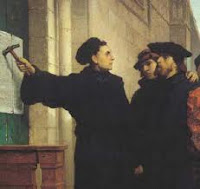
Do note, however, that this is not a "pie in the sky, by-and-by" sort of picture. Wearing Christ's righteousness will take us down paths that will not be easy. It will require us to take up our cross. That is the life of sanctification...following Jesus. Martin Luther's final two theses of the 95 say this:
94. Christians are to be exhorted that they be diligent in following Christ, their Head, through penalties, deaths, and hell;

95. And thus be confident of entering into heaven rather through many tribulations, than through the assurance of peace.
Notice the common language of Christ as our "Head" between Luther and Charles' lyrics above. But to return to the opening lyric of this verse, for those who walk in accordance with the Spirit (i.e., following Christ) there is no need to fear condemnation. It is not a matter of whether or not you recall a decision made in a point in time. It is a matter of whether or not you are walking with him now. Christ's cloth of righteousness will not stay on us if we don't move and follow him.

14 April 2011

And Can It Be? (v)

Update & disclaimer: when I posted what's written below, I was under the assumption that Charles Wesley wrote these lyrics with the remainder of the hymn. It has since been revealed to me, thanks to conversation with and investigation by Jonathan Powers, that this verse was not in Charles' composition but must have been added sometime later, which would explain its absence in most publications of the hymn. This verse is included on this page, which has a large compilation of hymns.

Verse 5
Still the small inward voice I hear,
That whispers all my sins forgiven;
Still the atoning blood is near,
That quenched the wrath of hostile Heaven.
I feel the life His wounds impart.
I feel the Saviour in my heart.

This is the only verse that does not appear in the United Methodist Hymnal. I've a hunch that the reasoning has to do with the fourth line and the language of "hostile Heaven." [Update: it also appears that Wesley didn't write this verse but this was added sometime later.] My friend Jonathan, who is a worship leader and has studied at length about Charles Wesley, said that he doesn't recall ever having heard or recited this verse in worship/song. He was aware of this verse, but was unable to recall the lyrics from memory like he is able to for the other verses of this hymn. We'll get to the more unsettled portion of this verse in a moment, but let's take the images of this stanza in order.

The first picture we have is the gentle voice of assurance that "all my sins [are] forgiven." Here the author combines the Scriptural imagery of Elijah's encounter with God on Mount Horeb in 1 Kings 19 with what appears to be an allusion to the witness of the Spirit ("inward voice"). Sometimes, like Elijah, we expect God to reveal himself in the grandiose (an earthquake, a fire, a thunderstorm), but what we get is a gentle whisper. It's not that forgiveness didn't come at a great and messy cost (the cross), for it did, but forgiveness is often instilled into our hearts gently and quietly. At the heart of the Lord's prayer is a prayer asking for forgiveness. Immediately prior, Jesus tells us to pray in secret. When my son breaks a rule in the house and we get to the point of confronting his wrong, he apologizes and I tell him, "I forgive you" while hugging him. I don't shout it. Forgiveness is whispered because it is told in the midst of embrace.

The atonement takes center stage in the third and fourth lines. Now, I understand the reasoning for omitting this verse because hostility implies a lack of control in today's usage of the term. It conjures up an image of unharnessed rage and destruction. I'm not sure what sort of reception this language of 'hostile Heaven' had in the days of when this verse was added, but what is clear is that the editor here is alluding to the theme of the atonement as propitiating the wrath/anger of God. To clarify, the Wesleys did not contend that wrath was an essential or eternal attribute of God, but was the passion/expression of his justice and its reaction to sin. John wrote in a letter:
Although, therefore, I do not term God, as Mr. [William] Law supposes, 'a wrathful Being,' which conveys a wrong idea; yet I firmly believe He was angry with all mankind, and that He was reconciled to them by the death of His Son. And I know He was angry with me till I believed in the Son of His love; and yet this is no impeachment to His mercy, that He is just as well as merciful.
(Note how love takes center stage and remains God's reigning attribute!) Matt O'Reilly posted recently on the issue of wrath and that we must see that wrath is not solely an expression about the Father's hatred of sin, but that wrath also exists in the other Persons of the Trinity. So, properly speaking, it is not as though the Father is placing His wrath on the Son against the Son's will, but that God is taking the wrath upon Godself (or absorbing it?) in the death of the God-human, Jesus. In that sense, it might be best understood, as Charles puts it in this hymn, that wrath is 'quenched.' The demands of holiness/justice are satisfied because of the sacrificial self-giving of the Son.

This nuance causes me to wonder about the reaction against the notion of God's wrath so prevalent in contemporary theological dialogue. Could it be that certain theologians are reacting more against the implications of a split Trinity (in which the image of a father inflicting his anger upon his son in rejecting him/turning away from him/etc.) than the notion of anger itself? Perhaps not, but maintaining the unity of purpose of the Persons of the Trinity in God's rescue plan that goes through the cross, would be one way of avoiding the pitfalls of many problematic expressions of penal substitutionary atonement. (Click here to see a line from John Wesley that shows the unity of purpose in the Godhead in redemption.)

The final two lines of this stanza return to the inner working of salvation by the editor's appeal to the feeling of new life that the presence of Christ brings when he enters into our hearts. Again we see the beauty of paradox in the picture that Christ's wounds heal us and give us life, an image found in Isaiah 53 and 1 Peter 2. Wounds that heal. 'Tis mystery all!

13 April 2011

And Can It Be? (iv)

Verse 4
Long my imprisoned spirit lay,
Fast bound in sin and nature's night;
Thine eye diffused a quickening ray--
I woke, the dungeon flamed with light;
My chains fell off, my heart was free,
I rose, went forth, and followed Thee.

This verse may well be the most beautiful combination of lyrics to illustrate sanctifying grace in all of poetry. To highlight sanctification in Wesleyan theological understanding, the picture of a prisoner in chains illustrates the bondage that sin keeps us in until Christ breaks the bond and sets us free from the power of sin. Whereas justification is oft described as the sinner's being set free from the guilt of sin, sanctification is being set free from sin's power. (There's really much more to the Wesleys' understanding of sanctification: for instance, John liked to use various phrases to describe it and preferred to speak about being made 'perfect in love' which conveys in part that TO which we are saved. But as it pertains to sin, i.e. what we are saved FROM, this is how it is best understood.)

For the Wesleys, prevenient grace is often imaged by the language of light. The passage to which John Wesley most frequently referred in speaking on prevenient grace was John 1.9: The light which enlightens everyone was coming into the world. Being in the midst of the prologue of St. John's Gospel, this clearly grounds the Wesleys' belief in prevenient grace upon the Person and work of Christ. So perhaps more accurately, we can say that this verse images the interchange of prevenient and sanctifying grace since even our response of rising, going forth, and following is enabled by the prior work of Christ. This clears the Wesleys from any false accusation of Pelagianism, whereby humans are capable of saving ourselves. From start to end, salvation is all grace.

To return to the picture of the prisoner in chains and its correspondence to sanctification, I recall on several occasions where Dr. Kenneth Collins made the following comment: "Forgiveness of sin without freedom from it is just polish for the chains that keep us bound." This is why salvation is so much more than being acquitted or being declared righteous. The angel told Joseph to name the child Jesus because he shall "save his people from (not in) their sin" (Matthew 1.21). In the theology of atonement, this imagery of a prisoner set free may have the closest affinity with the language of Christus Victor. It is a power-breaking grace that we are faced with. Christ breaks bonds that were impossible for us to break. If you recall in The Voyage of the Dawn Treader, Eustace (who had become a dragon) was unable to "undragon" himself. He was in bondage because of a bracelet around his wrist. Aslan (the Christ figure of the Chronicles of Narnia) had to peel off the dragon layers so that the bracelet could come off, and once that happened Eustace was able to go forth and follow the right path.

Where darkness, evil and death once reigned, Christ brings light, goodness, and life. He comes to break our chains so that we, like Charles confesses, can rise, go forth, and follow him!

12 April 2011

And Can It Be? (iii)

Verse 3
He left His Father's throne above
So free, so infinite His grace --

Emptied Himself of all but love,

And bled for Adam's helpless race:
'Tis mercy all, immense and free,
For O my God, it found out me!

Here we have Charles' beautiful lyrics of kenosis, Christ's humbling and self-emptying of himself. Many point to the Christ hymn of Philippians 2.5-11 (esp. verse 6 - "emptied") as the key Scriptural text for kenosis, although others read the passage through the lens of Christ as Second Adam. I don't see why both can't be at the heart of the passage. Kenotic theology maintains the full divinity of Christ though he suspended certain attributes from his conception to his ascension (see, for instance, Mark 13.32, which conveys that Jesus is unaware of when the final judgment would take place). To read Philippians 2 through the lens of Christ as Second Adam is to affirm his full humanity, his obedience in undoing the sin of Adam, which had 'grasped at equality with God' through disobedience. One of my favorite quotations comes from St. Irenaeus' On the Apostolic Preaching where he interprets the significance of the cross, and he seems to suggest the combination of these two themes:
And the transgression which occurred through the tree [of knowledge of good & evil] was undone by the obedience of the tree [the cross]--which [was shown when] the Son of Man, obeying God, was nailed to the tree, destroying the knowledge of evil, and introducing and providing the knowledge of good.
...of all but love. Again we see that love is God's reigning, his "darling attribute" as we saw in verse 1. Charles is obviously engaging in a bit of hyperbole, for he certainly didn't mean to imply that Christ let go of attributes such as justice, holiness, righteousness, and so forth. The point is that love (and we should couple mercy with it, seeing it at the heart of this verse) is the chief motivation of God's redemptive action in Christ. I say we should couple 'mercy' with love because the Wesleys saw them that way. In a letter to William Law, one of John's mentors, John stressed as much when he said that "love and anger [are] the passions (speaking after the manner of men) which correspond with the dispositions of mercy and justice." Mercy also belongs here because of what we find in the next line of the hymn: that we, Adam's race, were helpless. Christ bled and died to bring us to a helped state. It takes humility to recognize that the only way to life is to admit our own helplessness. It's no accident that it took Christ's humility to lift us out of helplessness.

I have the image of a lost sheep in my mind here. That is the image of helplessness. 'Tis mercy all! that Christ would enter into harm's way to find a stupid sheep like me, who brought this own helplessness upon myself. That mercy has found me! This was at the heart of the Wesleys' experience(s) and evangelical manifesto in 1738. Christ died for the world and is the savior of the world. They knew that! But they'd never personalized it the way St. Paul had in Galatians 2.20, where he affirms that Christ loved me and gave himself for me!

11 April 2011

And Can It Be? (ii)

Verse 2
'Tis mystery all: th'Immortal dies:
Who can explore His strange design?
In vain the firstborn seraph tries
To sound the depths of love divine.
'Tis mercy all! Let earth adore,
Let angel minds inquire no more.

I performed a search over at the Wesley Center Online to see if much had been written on this verse in particular. Nothing much showed up, but I found a series of sermons compiled into a book that were preached by P.F. Bresee. He quotes this verse in one of the sermons and writes some beautiful words that speak of this mystery that Charles Wesley was speaking to in this verse...that darkness and hope meet at the cross:
That is a marvelous utterance of the Spirit through the prophet Hosea -- "I will give her the valley of Achor for a door of hope." Achor was the dark place -- the place of disaster, defeat, wreck; and that place of darkness is made a door of hope. Where the wreck and ruin came, there the Cross is raised. Sin has caused the awful blight and curse, but right in the very place where the curse falls, there the Blood flows. The Lamb of God dies to take away the sin of the world.

The Son of God has made the darkest place of human history the most luminous place in this universe. Every thing is dim beside it. Ten thousand suns gathered into one, would be blackness itself compared to the unspeakable glory of the cross of Christ. The Cross is the great suffering, infinite, crowning glory of God. It is the mighty, struggling, dying effort to do what omnipotence can not do; to accomplish the impossible; to cause infinite justice and infinite mercy to kiss each other over the brow of a doomed man, and folding their arms about him, lift him to a new possibility. To the amazement of a moral universe it is done. Infinite love, infinite suffering bring it to pass.
'Tis mystery all! Moving into the lyrics themselves, in the last post, I suggested that Charles wasn't making an explicit theological statement about divinity dying. You might think that it would be best for me to back off from my assessment of Charles given his statement here, 'th'Immortal dies', but I still don't think he's making a doctrinal claim except the orthodox one that Christ is God (the Immortal one) from eternity (see Revelation 1.17-18). We saw similar claims from Charles in the series on the Nativity hymns we examined in December last year, which drew upon the rich paradox of God becoming Incarnate. The mystery and miracle of the Incarnation began in the Virgin womb and reaches a new height in the cross. But the story, as we know, was not over at Calvary. It couldn't be, but it had to go there.

Who can explore this strange design? For indeed, it is a mystery. As is true in many areas of theology (and life), when it comes to the death of Jesus, we must begin and end in the realization that we cannot exhaust its meaning. We cannot fully explore it. If we begin there, in worship and awe and humility, then we have the freedom to explain what is clear and admit what we ultimately do not and cannot know. The atoning death of Jesus is not a puzzle that needs to be pieced together. It is a mystery that we cannot ultimately explore in a way that we can explore the earth.

There's a funny clip in The Truman Show where Truman recounts his days in elementary school where he told his teacher that he wanted "to be an explorer, like the great Magellan!" His teacher (who had to take part in the ploy to keep Truman in the bubble created for his life) pulled down a map of the world and said: "Oh, you're too late! There's nothing left to explore." You and I are not made to wrap our heads around the atonement. It is bigger than our heads. If it weren't, then it wouldn't be much, would it? That's why there's something freeing about beginning with mystery and keeping that at the heart of Jesus' death, as Charles does here. In Psalm 31, John Wesley's notes convey the atonement as mystery when he says: ...the secret of God's tabernacle, as it is called, Psalm 27.5, the place of God's special presence, where none might enter save the high-priest. With thy secret favour and providence, which saves them by hidden and unknown methods.

Even angel minds cannot grasp the depths of love divine. Who are humans that You are mindful of us...that You care for us...that You'd become one of and die for us? It takes a good dose of humility and trust to adore something you cannot grasp, but that is what is asked of us when it comes to the death of Christ. But humility, trust, and adoration is truly freeing as we realize that the depths of the reality of God's love is beyond comprehension, yet we can truly experience it! 'Tis mercy all! Let earth adore...

09 April 2011

And Can It Be? (i)

Verse 1
And can it be that I should gain
An interest in the Saviour's blood?
Died He for me, who caused His pain-
For me, who Him to death pursued?
Amazing love! How can it be,
That Thou, my God, shouldst die for me?

So begins one of the theologically richest hymns ever written. Written by Charles Wesley, many say that if Methodism were to have a fight song this would unquestionably be it.

Thanks to Jonathan Powers' direction, I was taken to this article, which is a snippet about some of the background of Charles' writing the hymn. For instance, the hymn was first published under the title 'Free Grace,' which is interesting given that one of John Wesley's most famous sermons shares the same title (another reason to make this the fight song of Methodism). The lyrics, the author of the article notes, relates closely to Charles' special experience on May 21, 1738 (three days before his brother John's experience at Aldersgate where his heart was "strangely warmed"). Although rules of grammar are suspended to a certain degree when it comes to poetry, I am struck that this hymn begins with a coordinating conjunction: "And can it be...". I wondered if this meant that Charles originally had this hymn as a follow-up to a previous hymn or if it had some sort of poetical or theological significance. With no evidence that I've seen to the former, the latter seems most probable. Since Jonathan (mentioned above) is more of an expert on Charles and on hymnody in general, I asked him. He responded with this insightful thought: "By using 'And'+ it marks the song as a response/reflection on conversion." This strengthens the case that this hymn is deeply connected to the experience referenced above, an experience (similar to John's) that many call Charles' conversion.

The hymn begins with a coordinating conjunction because this hymn marks the response of someone who is in awe of the extent of God's love. Or, as the author of the article above put it, "The questions that open the hymn are a remarkable reiteration of the perplexion faced by one who is confronted by the wonder of God’s forgiving love...This mystery is at the heart of God’s love and mercy, which is inexplicable even to the angels. We are left simply to adore the depths of divine mercy."

This is that upon which this hymn is grounded. This is that upon which our salvation is founded: God's infinite, perplexing, and forgiving love! In Charles' journal on 14 August 1741, he records this:
I went after a stray sheep, who was turned out of the way by the predestinarians; but the good Shepherd had found her himself, and brought her home rejoicing. For some days she had been under the full influence of that narrow opinion, and could not bear any of her brethren and sisters. Then she cried unto the Lord to show her the truth, and he answered her by his own mouth. The true light broke in upon her, and in his light she saw that God is love. She is now humbled in the dust before him, for having "robbed him of his most darling attribute."
Notice that he says it is love that is God's "darling attribute." We'll see the theme of 'light breaking in' in another verse, so stay tuned for that. Interestingly, the topic of John's sermon 'Free Grace,' Charles' journal entry above, and John's treatise 'Predestination Calmly Considered' all center on the controverted issue of predestination and the Wesleys' disagreement with the Calvinists' take of the issue. But in all of these (and more), it is 'love' that is at the heart of God's nature and hence God's intent in saving fallen humanity. John, in 'Predestination Calmly Considered':
So ill do election and reprobation agree with the truth and sincerity of God! But do they not agree least of all with the scriptural account of his love and goodness? that attribute which God peculiarly claims, wherein he glories above all the rest. It is not written, “God is justice,” or “God is truth” (although he is just and true in all his ways). But it is written, “God is love,” love in the abstract, without bounds; and "there is no end of his goodness."
Two final points that probably deserve much more consideration. First, the lyrics 'gain an interest in the Saviour's blood' convey the metaphor of sin as debt and atonement as redemption (or perhaps ransom) with the language of commerce in gaining interest. This should not be read to suggest that 'ransom' or commercial atonement theology governs the Wesleys' (or at least Charles') approach to the atonement. Indeed, this hymn will go on to portray other themes that lay at the heart of Jesus' atoning death, but it does show that there is something immeasurable we gain in the death of Jesus. I think this is conveyed somewhat in 'How Deep the Father's Love for Us' by Stuart Townend in the lyrics:
Why should I gain from his reward?
I cannot give an answer.
But this I know with all my heart:
His death has paid my ransom.
Second (and finally), in relation to the recent posts about Tertullian's and Cyril of Alexandria's takes on the Godhead at the cross (you'll want to read the couple of comments on each post) comes the question of the final part of this verse: what did Charles import into "That Thou, my God, shouldst die for me?" Jonathan raised this question in the comments on the post about Tertullian. Though I could be mistaken as to Charles' meaning, I don't think he was making a theological argument to suggest that Christ's divinity died at the cross. If he was doing that, then I think he stood in opposition to the conclusions of the early church (most notably Cyril's theology, affirmed in the Council of Chalcedon). I rather think that Charles was using 'my God' as an expression much like Thomas cried in John 20.28. Charles rightly recognizes that Jesus is indeed "My Lord and my God!" It is an exclamation that, returning to an earlier point, shows our wonder at the infinite and perplexing breadth and depth of God's love, God's 'free grace'!