Hey all,
This post is long overdue, but I have a website that I update on a more regular basis and reflects the change I've made vocationally to pastoral ministry and away from my pursuit to be a professor. You can read about that transition in this post.
I may post on here from time to time if something of particular interest to Wesleyan and early Methodist studies comes up I want to write about. But until then, I invite you to join the conversations over at wesleyanrudy.com.
Pax!
Jeff
31 January 2013

01 September 2011
What are you looking for?

There are times in doing research in theology when something will start to dig not only into my mind for research and educational purposes, but also into the core of my very being and really search me. Reading from luminaries like Jeremy Taylor, author of The Rule and Exercises of Holy Living and Holy Dying, will do this perhaps more frequently than others. (Taylor's work was an influence upon John Wesley, which is why I found it appropriate for this blog.) Today I'm reading through Taylor's treatise, Jesus Christ - The Great Exemplar. The section that grabbed me was his exposition of the passage of the magi's visit to the child Jesus (cf. Matthew 2). His statements on the joys of finding what you're looking for stood out to me and I thought I would share.
The wise men prosecuted the business of their journey, and "having heard the king, they departed; and the star" (which, as it seems, attended their motion) "went before them, until it came and stood over where the young child was"; where "when they saw the star, they rejoiced with exceeding great joy"; such a joy as is usual to wearied travellers when they are entering into their inn; such a joy as when our hopes and greatest longings are laying hold upon the proper objects of their desires; a joy of certainty immediately before the possession: for that is the greatest joy which possesses before it is satisfied, and rejoices with a joy not abated by the surfeits of possession, but heightened with all the apprehensions and fancies of hope and the neighbourhood of fruition; a joy of nature, of wonder, and of religion.With what I am pursuing in life, can I look into the future and say with surety or at least expectancy that when I achieve it or find it that I will be exceedingly joyful? What are you pursuing?
14 July 2011
A Wesleyan Appropriation of the Cry of Dereliction - Part 4
In concluding this series on exploring a Wesleyan interpretation of the cry of dereliction, we will pick up where we left off the last post, which appealed to Wesley's belief of Christ's human will as submissive to the will of God. This, in my view, leads naturally to what I see as the richest pastoral payoff for this passage.
It is worthy to note that in the sermon The Repentance of Believers, cited in the previous post, Wesley’s exhortation was that our will would be less self-directed and more in submission to the will of God. That is, Christ’s human will in subjection to the will of God is the image of our sanctification...what it looks like for someone who expresses his or her trust in God, even when God seems to be hiding or distant. I think we see this in Wesley’s interpretation on the beatitude, ‘Blessed are they that mourn, for they shall be comforted':
 Whether or not Wesley really had this connection of Christ and our sanctification in mind, I am unsure. But I cannot but draw this conclusion. The battle against sin and temptation is clearly in view, and by submitting to the will of the Father and only seek consolation through the Spirit, even when we ‘cannot see God,’ we move forward to victory in sanctification, just as Christ continued to pour out his heart to his Father even through death. 'Blessed is the one who steadily refuses all other comfort...' Sound like Christ on the cross? The Roman centurion even noticed that there was no enmity between the man who died on the cross and God, but even declared him as God's Son! The will that is submitted to God is not afraid to mourn or scream at injustice. It may just be the sign of someone who is more in tune with God (read: sanctification) than most everyone else. In this light, we might be well on our way toward a Wesleyan appropriation of the cry of dereliction and sing with John and his brother Charles Wesley, who once wrote,
It is worthy to note that in the sermon The Repentance of Believers, cited in the previous post, Wesley’s exhortation was that our will would be less self-directed and more in submission to the will of God. That is, Christ’s human will in subjection to the will of God is the image of our sanctification...what it looks like for someone who expresses his or her trust in God, even when God seems to be hiding or distant. I think we see this in Wesley’s interpretation on the beatitude, ‘Blessed are they that mourn, for they shall be comforted':
But he now ‘hides his face, and they are troubled:’ They cannot see him through the dark cloud. But they see temptation and sin, which they fondly supposed were gone never to return, arising again, following after them again, and holding them in on every side. It is not strange if their soul is now disquieted within them, and trouble and heaviness take hold upon them...Blessed are they who…steadily refuse all other comfort. They shall be comforted by the consolations of his Spirit.
 Whether or not Wesley really had this connection of Christ and our sanctification in mind, I am unsure. But I cannot but draw this conclusion. The battle against sin and temptation is clearly in view, and by submitting to the will of the Father and only seek consolation through the Spirit, even when we ‘cannot see God,’ we move forward to victory in sanctification, just as Christ continued to pour out his heart to his Father even through death. 'Blessed is the one who steadily refuses all other comfort...' Sound like Christ on the cross? The Roman centurion even noticed that there was no enmity between the man who died on the cross and God, but even declared him as God's Son! The will that is submitted to God is not afraid to mourn or scream at injustice. It may just be the sign of someone who is more in tune with God (read: sanctification) than most everyone else. In this light, we might be well on our way toward a Wesleyan appropriation of the cry of dereliction and sing with John and his brother Charles Wesley, who once wrote,
O Jesu, let thy dying cry
Pierce to the bottom of my heart,
Its evil cure, its wants supply,
And bid my unbelief depart.
13 July 2011
A Wesleyan Appropriation of the Cry of Dereliction - Part 3
In continuing the exploration of a Wesleyan interpretation of Jesus' cry of dereliction ("My God, my God, why have you forsaken me?"), the last post centered on the Trinitarian question as we noted the vital importance of maintaining a unity in the essence and purpose among the Persons of the Godhead. Seeing that the Son and the Father, together with the Spirit, are eternally of the same substance, we see that any suggestion of a split or separation of the Godhead at any point brings disastrous implications. In this post, we will see what, if any, insights of the doctrine of Christ's two natures (fully divine, fully human) can provide for the question of Christ's desperate cry.
Several early church fathers suggested that the cry is according to the flesh or according to his humanity. For the sake of space, we will appeal only to St. Ambrose, who in, The Sacrament of the Incarnation of Our Lord, wrote:

 Secondly, it could be that the cry of dereliction is an example that highlights that there were two wills in Christ, just as there are two natures. Accordingly, Jesus' cry from the cross might be seen in comparison with his earnest pleading in the Garden of Gethsemane, perhaps the most well-known passage that appeals to the two wills in Christ, when he prayed for the cup to pass from him, "nevertheless, not my will but yours be done."
And in this case, there is evidence of Wesley’s support of Christ’s two wills. In The Repentance in Believers, John Wesley stated the following:
Several early church fathers suggested that the cry is according to the flesh or according to his humanity. For the sake of space, we will appeal only to St. Ambrose, who in, The Sacrament of the Incarnation of Our Lord, wrote:

According to the flesh, He was forsaken, who according to divinity could have been neither deserted nor forsaken…These words [‘Why hast thou forsaken me’] are said according to the flesh, which are very foreign to the fullness of His divinity, for the words of sins are foreign to God, since the sins of words are also foreign to Him; but since I [Christ] have assumed the sins of others, I have assumed also the words of others’ sins, so that I say that I, who am always with God, have been forsaken by God the Father.In his, On the Christian Faith, St. Ambrose offered another note on the passage that might clarify the issue further, especially in referring to the dereliction as a perceived abandonment:
Finally, He cried: “My God, My God, why hast Thou forsaken Me?” As being man, therefore, He speaks, bearing with Him my terrors, for when we are in the midst of dangers we think ourself abandoned by God. As man, therefore, He is distressed, as man He weeps, as man He is crucified.One might think that this borders too closely to, if it doesn’t cross over into, Nestorianism, which divided the two natures to such a degree that there is no unified person, but two persons. In avoiding this error, it is worthy to note, firstly, that St. Ambrose wrote prior to the Nestorian controversy. Even so, he did not separate Christ into two persons, but instead affirms Christ's assumption of humanity. What we humans experience, God has assumed in the Person of the God-human.
 Secondly, it could be that the cry of dereliction is an example that highlights that there were two wills in Christ, just as there are two natures. Accordingly, Jesus' cry from the cross might be seen in comparison with his earnest pleading in the Garden of Gethsemane, perhaps the most well-known passage that appeals to the two wills in Christ, when he prayed for the cup to pass from him, "nevertheless, not my will but yours be done."
 And in this case, there is evidence of Wesley’s support of Christ’s two wills. In The Repentance in Believers, John Wesley stated the following:
[A will] is an essential part of human nature, indeed of the nature of every intelligent being. Our blessed Lord himself had a will as a man; otherwise he had not been a man. But his human will was invariably subject to the will of his Father.I realize that much of what I've said and appealed to may be rather complicated and perhaps is attempting to address something beyond our capacity to understand. It is not my interest to explore this question merely as an academic or intellectual exercise. I really believe this theological unpacking has a significant pastoral payoff, and I intend to tease out at least one significant conclusion, a distinctively Wesleyan one that will pick up on this last quote from Wesley, in the next and final post in this series. If you're still with me, thanks for following and I look forward to any criticism or questions you may have.
12 July 2011
A Wesleyan Appropriation of the Cry of Dereliction - Part 2

In the last post, I introduced a series that would begin to explore a Wesleyan interpretation of Jesus' cry of dereliction, "My God, my God, why have you forsaken me?" I concluded the post by saying that it is reasonable to suggest that John Wesley held that whatever is meant by God's hiding his face from Jesus, it should be read analogically. Even if Wesley did not explicitly make this statement, I think this conclusion is the only way to avoid a tragedy of creating a rift within the Holy Trinity. This short post will draw attention to the unity of the Godhead in saving the world. This, according to Wesley, is the ground of our redemption, which has its apex at the cross of Christ.
Whatever else might be implied by Wesley’s definition of ‘forsaken’ and his comments on the Father’s face being hidden, on no occasion does Wesley suggest that there is ever (even on the cross) any animosity between the Persons of the Godhead. The movement of redemption is not solely the work of the Son of God. Wesley suggests that all Persons in the Trinity are at work in redemption in a letter to William Law. In a section of the letter that he borrowed from Anna Maria Van Schurman’s journal, he quotes her as saying:
The origin and cause of our redemption is the ineffable love of God the Father, who willed to redeem us by the blood of His own Son; the grace of the Son, who freely took our curse upon Him, and imparts His blessing and merits to us; and the Holy Spirit, who communicates the love of the Father and the grace of the Son to our hearts.Readers of my blog may have seen this quote posted before, which I did here. In addition to this unity of a redeeming purpose, Wesley also advocated, in orthodox fashion, the unity of essence among the divine Persons, and makes this especially known in his strong defense of the full divinity of Christ. Christ is of the same essence as the Father and the Spirit. If there is any "split" or "separation" in the Godhead at the cross, then this is unquestionably advocating polytheism.
I've posted before on drawing wisdom from the Fathers of the Church on this matter, but I think the thoughts from Saints Athanasius and Chrysostom on the cry of dereliction are worth repeating. St. Athanasius:
For behold when He says, "Why hast Thou forsaken Me?" the Father shewed that He was ever and even then in Him; for the earth knowing its Lord who spoke, straightway trembled, and the vail was rent...then seeing these signs, [the centurion] confessed that "truly He was the Son of God."And St. Chrysostom:
That darkness [at the cross] was a token of the Father's anger at their [the crowd's] crime...He saith, "Eli, Eli, lima sabachthani?" that unto His last breath they might see that He honors His Father, and is no adversary of God...and by all things, He shows how He is of one mind with Him that begat Him.If we suggest, in the fashion of Wesley, that in Jesus' death, the wrath of God was assuaged or propitiated (an issue that needs to be addressed, but is too much for this post), we must not read this so strictly that it breaks the bond and unity of essence among the divine Persons. Otherwise, we'd have one god saving us from another.
Seeing the significance of maintaining the unity of essence and purpose between the Father, the Son, and the Spirit, we will next address how the doctrine of Christ's two natures may speak to the issue of Jesus' dereliction cry.
07 July 2011
A Wesleyan Appropriation of the Cry of Dereliction - Part 1
I apologize for the sparse posting of recent: I spent much of June preparing for a paper I presented at a colloquium in Manchester, from which I have shared a brief piece with you in the last post on impassibility. In the next few posts, I want to share some of the conclusions I have come to in regards to exploring a Wesleyan appropriation of Jesus' cry of dereliction at the cross ("My God, my God, why have you forsaken me?").
As you can read on this post, I have written bits and pieces on this issue, but in the next posts I will be sharing how this issue developed into the paper I presented. The paper was much more lengthy than what I'm going to share, so I'll cut right to the chase on the issues I see at stake.
 When it comes to addressing the question of the significance of Jesus' cry from the cross, it is vital to turn to Psalm 22, seeing that Jesus was quoting that Psalm. John Wesley's introduction to his notes on Psalm 22 made it clear that he read the Psalm through the lens of Christ in saying that it was:
Many of Wesley’s notes throughout the Psalm are valuable for ascribing different verses therein directly to Christ on the cross. Potential difficulty arises, however, when we view Wesley's comments on the meaning of ‘forsaken'ness (v. 1) as applied to Christ as well as Wesley’s clarifying comment on the affirmation that God had not hid his face from the psalmist/Christ (v. 24), which is where we will direct our attention in this post.
On the word ‘forsaken’ Wesley interprets it as though Christ is saying: ‘[My God, Why have you] withdrawn the light of thy countenance, the supports and comforts of thy spirit, and filled me with the terrors of thy wrath’ and then adds in commenting that ‘this was in part verified in David, but much more fully in Christ.’ In verse 24, the psalmist says, ‘For he hath not despised nor abhorred the affliction of the poor: neither hath he hid his face from him, but when he called unto him, he heard.’ Wesley qualifies this significantly in taking ‘[neither hath he hid his face] from him’ to mean ‘for ever: tho’ he did so for a time.’ Said otherwise, according to Wesley, God hid his face from Jesus for a short time, though he does not specify if this was only a brief moment on the cross, for the duration of the crucifixion, or perhaps even from his praying in the Garden of Gethsemane. On Luke 22:44, in the midst of the passage of Jesus' praying in the Garden, Wesley noted that Jesus was ‘Probably just now grappling with the powers of darkness: feeling the weight of the wrath of God.’ That he began to feel God’s wrath even then might suggest that, according to Wesley, God’s face might have been hid from this moment. Wesley’s note on Jesus’ cry in Matthew’s gospel (27:46) does not clear this up but conveys, similarly,
If he saw the first part of Psalm 22:24 as analogical, then it is reasonable, though by no means definitive, to suggest that Wesley read the latter part, of God hiding his face from Jesus, analogically also.
In the remaining posts of this series, we'll look at the issue of Jesus' abandonment, whether it was real or perceived, look to a few Patristic sources as well as some more interaction with Wesley in relation to that question.
As you can read on this post, I have written bits and pieces on this issue, but in the next posts I will be sharing how this issue developed into the paper I presented. The paper was much more lengthy than what I'm going to share, so I'll cut right to the chase on the issues I see at stake.
 When it comes to addressing the question of the significance of Jesus' cry from the cross, it is vital to turn to Psalm 22, seeing that Jesus was quoting that Psalm. John Wesley's introduction to his notes on Psalm 22 made it clear that he read the Psalm through the lens of Christ in saying that it was:
 …directly, and immediately intended for, and [was] properly to be understood of the Messiah…[and was held to be so] by the Hebrew doctors themselves, and by Christ himself and by his apostles. And there are many passages in it, which were literally accomplished in him, and cannot be understood of any other. In this psalm David speaks of the humiliation of Christ, ver. 1 - 21. Of the exaltation of Christ, ver. 22 - 31.
Many of Wesley’s notes throughout the Psalm are valuable for ascribing different verses therein directly to Christ on the cross. Potential difficulty arises, however, when we view Wesley's comments on the meaning of ‘forsaken'ness (v. 1) as applied to Christ as well as Wesley’s clarifying comment on the affirmation that God had not hid his face from the psalmist/Christ (v. 24), which is where we will direct our attention in this post.
On the word ‘forsaken’ Wesley interprets it as though Christ is saying: ‘[My God, Why have you] withdrawn the light of thy countenance, the supports and comforts of thy spirit, and filled me with the terrors of thy wrath’ and then adds in commenting that ‘this was in part verified in David, but much more fully in Christ.’ In verse 24, the psalmist says, ‘For he hath not despised nor abhorred the affliction of the poor: neither hath he hid his face from him, but when he called unto him, he heard.’ Wesley qualifies this significantly in taking ‘[neither hath he hid his face] from him’ to mean ‘for ever: tho’ he did so for a time.’ Said otherwise, according to Wesley, God hid his face from Jesus for a short time, though he does not specify if this was only a brief moment on the cross, for the duration of the crucifixion, or perhaps even from his praying in the Garden of Gethsemane. On Luke 22:44, in the midst of the passage of Jesus' praying in the Garden, Wesley noted that Jesus was ‘Probably just now grappling with the powers of darkness: feeling the weight of the wrath of God.’ That he began to feel God’s wrath even then might suggest that, according to Wesley, God’s face might have been hid from this moment. Wesley’s note on Jesus’ cry in Matthew’s gospel (27:46) does not clear this up but conveys, similarly,
Our Lord hereby at once expresses his trust in God, and a most distressing sense of his letting loose the powers of darkness upon him, withdrawing the comfortable discoveries of his presence, and filling his soul with a terrible sense of the wrath due to the sins which he was bearing.It is clear that, for Wesley, God’s wrath is intricately linked with whatever is meant by God’s hiding his face from Christ. Although Wesley does not go so far as to say there was an actual separation or a split in the Godhead, which is the conclusion some are unafraid to explicitly embrace, the implications of this idea upon the doctrine of the Trinity are potentially disastrous. The thing that may rescue Wesley from committing a grievous error in rending apart the Persons of the Trinity might be in his comment on the first part of verse 24, when he clarifies that God had not ‘abhorred…’ in saying, ‘He did not turn away his face from it, as men do from things which they abhor.’ Wesley, it seems, interpreted at least this part metaphorically in that we should not equivocate human actions or emotions with those of God. Perhaps this is related to what Wesley said in his notes on Romans 5:9 on the nature of God’s wrath:
Wrath in man, and so love in man, is a human passion. But wrath in God is not a human passion; nor is love, as it is in God. Therefore the inspired writers ascribe both the one and the other to God only in an analogical sense.
If he saw the first part of Psalm 22:24 as analogical, then it is reasonable, though by no means definitive, to suggest that Wesley read the latter part, of God hiding his face from Jesus, analogically also.
In the remaining posts of this series, we'll look at the issue of Jesus' abandonment, whether it was real or perceived, look to a few Patristic sources as well as some more interaction with Wesley in relation to that question.
18 June 2011
Impassibility: the analogy of a house fire
 Paul Gavrilyuk, professor of historical theology at the University of St. Thomas in Minneapolis, has written at length on the complex nature of divine impassibility. His most noteworthy contribution is The Suffering of the Impassible God: The Dialectics of Patristic Thought, which I highly recommend. Among other things, he notes that the common accusation that the early church uncritically adopted the Greek philosophical concept of divine impassibility is simply not true to the historical record. I could go on, but my point in this post is to share an analogy he used in his book to draw out some of the variant meanings of suffering & compassion.
Consider the case of a house on fire. Several people are unable to exit the building and cry aloud desperately for help. Firemen have been called, but for some reason they do not come. A crowd is gathering around the house. Some stare at the house with a mixture of anxiety, fear, and curiosity. Some attempt to visualize as vividly as possible what the people who are in the house must be going through. These members of the crowd burst into tears, yell, tear their hair; in short, they are greatly emotionally affected. One of them has already had a fit and lies unconscious. Another has become mad and predicts the end of the world. Yet another person decides literally to suffer with those who are in the house and commits suicide by burning himself. Panic grows. A certain man from the crowd, without going through all the emotional pangs that those standing near him are experiencing, being motivated only by his conviction that the people will surely die if there is no one to help them, gets into the house and, at great risk to his own safety, rescues them. If it is asked, who out of al the people that were present at the scene manifested genuine compassion, the answer is obvious. (p. 10)This issue of divine impassibility has been at the heart of the current phase of my doctoral thesis. It has been one of the most difficult questions to pursue, but it's drawn me back, once again, to be in awe and worship of the God who would stop at nothing to rescue us from sin and death.
26 May 2011
Sparse posting...working on a project...
I apologize for the sparse posting as of recent. My publishing energies at this point are focusing on a paper presentation I'm working on for the MWRC Colloquium in mid-June, where my topic is on Christology and the death of Jesus in Wesleyan theology. In particular, I'm focusing on the interpretation of Jesus' cry of dereliction ("My God, my God, why have you forsaken me?"). I've posted a few times on Jesus' cry and its relation to Psalm 22. Here are the posts related to the topic:
To give you a little foretaste of where I think I'm heading... it appears to me that when certain theologians have made problematic conclusions of the implications of this passage (e.g., that there is a split or separation in the Trinity, at least between the Father and the Son), it is because they have immediately taken the passage to the doctrine of the Trinity rather than first addressing the doctrine of Christ's two natures. Once we determine exactly what the cry means and where it is coming from within Jesus, then it is appropriate to raise any Trinitarian questions, but not until then (in my opinion). There appears to be unanimity from the interpreters of the early centuries that when Jesus makes this cry it is from his human nature. There are other significant implications of the passage that early luminaries have drawn out that are related to this insight, but I'll save those for later. As for Wesley's take himself, he doesn't explicitly draw this conclusion (and as I have posted before, he draws conclusions that I find problematic), but I think that several statements he makes elsewhere and his Christology in general finds congruence with the interpretation of the early centuries.
After I finish the paper, I'll share some of the conclusions I'll have drawn as well as some questions that remain unanswered.
17 May 2011
Some of My Reflections on the Church Calendar...
...can be found in a guest post I did for the Weekly Wesley. I appreciate Aaron's invitation to join the conversation. There have been some other voices who have treated the topic more ably than I have, so be sure to check out the immediately previous entries.
Experimenting...
Been thinking on the resurrection and undoing what will rot...so I'm doing some (very) amateur experimentation with poetry here:
That which brought
Us to rot,
Lo! He has brought to naught.
Behold our lot
We were bought,
So dying to death we ought.
13 May 2011
A good shepherd
An extract from another Reginald Mallett sermon...
Edward Rogers told us how on this particular Sunday as he and the family were just about to begin lunch there was a loud knocking at the front door. It was one of the farmer's neighbors. "Quick," the neighbor cried, "Your sheep are in the wire." It was obvious that this was a fairly common emergency to which the family was accustomed. As if on cue they all immediately rose from the table and rushed out to rescue the sheep. Edward Rogers confessed that, wearing a clerical collar, he could not sit idly by so he reluctantly offered his services. He was assigned one part of the field and as he went amongst this high grass, searching for sheep he said dryly, "I was unlucky, I found one!" He struggled to extricate it from the barbed wire as the terrified animal wrestled with him. Eventually, he finished up with the sheep in his arms, although he confessed that he was not sure whether he was carrying the sheep or the sheep was carrying him. Just then, the farmer arrived on the scene. "Here, let me have that sheep Mr. Rogers," he said. Rogers then told us how the farmer, a big, strong man, his sleeves rolled up, arms lacerated and bleeding from encounters with barbed wire, took hold of the front paws of the sheep in one big fist and the rear paws in the other. He then slung the sheep on his back like a sack of coal and carried it to safety. The preacher concluded, "Now when I think about the good shepherd, I see that strong man, his arms torn and bleeding, carrying that stupid, struggling, frightened creature from danger to safety."
"I am the good shepherd," our Lord tells us. "The good shepherd lays down his life for the sheep."
09 May 2011
"...till the time of his trial should be ended." (?)
Seeking your assistance here. I'm reading John's sermon, 'Justification by Faith' and came upon something I hadn't noticed before. This statement is early in the sermon, where he is establishing the general ground for the doctrine of justification by faith. He begins, appropriately, in the creation, but he includes this phrase that I'm not altogether sure what he implies. It's the part in bold below (and also shown in the title of this entry).
 What do you think he meant by this? Did Wesley have a supposition of how history might have panned out differently had Adam & Even remained obedient? I'm aware that theologians in the Orthodox Church (from St. Irenaeus) maintain that even had 'The Fall' not happened, that the Word still would have been made flesh. There is a clarification to be made here in what is meant by 'perfect': i.e., just how 'perfect' were our first parents created? St. Irenaeus speaks of Adam & Eve as innocent, though he calls them infants/children. This infers that humans were created with 'room for growth,' as it were. This view, the way I understand it at this point, maintains that Adam & Eve were created 'good' but not 'perfect,' at least not in the absolutist sense. Hence, the goal would be that humans would grow and that the Incarnation would perfect the humanity, uniting us to the Triune God in a way that our first parents were not (originally, anyway). It is the progression from the "external" to the "internal".
 One might read such into Wesley's phrase above, but in his multiple declarations of the felix culpa tradition where he speaks of 'the fall' as the "happy fault," Wesley says that had it not been for the original sin, then we would not have known Christ because sin was the very grounds for and necessitated the Incarnation (see sermons 'On the Fall of Man' and 'God's Love to Fallen Man'). Furthermore, he says that in the wake of the Incarnation that humans can now enjoy higher degrees of happiness and holiness than humanity prior to the fall. This idea seems to be derived scripturally from Romans 5.20: "But where sin increased, grace increased all the more." So in a sense, they argue for a similar conclusion (that humanity in Christ enjoys something of a higher degree than our first parents) but take very different avenues to get there (St. Irenaeus: this was part of the plan even before the sin; felix culpa tradition: it is because of the sin that this is possible). So if Wesley falls in this latter camp, then I return to the question: what does he mean by this phrase "...till the time of his trial should be ended"?
To man thus upright and perfect, God gave a perfect law, to which he required full and perfect obedience. He required full obedience in every point, and this to be performed without any intermission, from the moment man became a living soul, till the time of his trial should be ended. No allowance was made for any falling short: As indeed, there was no need of any; man being altogether equal to the task assigned, and thoroughly furnished for every good word and work.
 What do you think he meant by this? Did Wesley have a supposition of how history might have panned out differently had Adam & Even remained obedient? I'm aware that theologians in the Orthodox Church (from St. Irenaeus) maintain that even had 'The Fall' not happened, that the Word still would have been made flesh. There is a clarification to be made here in what is meant by 'perfect': i.e., just how 'perfect' were our first parents created? St. Irenaeus speaks of Adam & Eve as innocent, though he calls them infants/children. This infers that humans were created with 'room for growth,' as it were. This view, the way I understand it at this point, maintains that Adam & Eve were created 'good' but not 'perfect,' at least not in the absolutist sense. Hence, the goal would be that humans would grow and that the Incarnation would perfect the humanity, uniting us to the Triune God in a way that our first parents were not (originally, anyway). It is the progression from the "external" to the "internal".
 One might read such into Wesley's phrase above, but in his multiple declarations of the felix culpa tradition where he speaks of 'the fall' as the "happy fault," Wesley says that had it not been for the original sin, then we would not have known Christ because sin was the very grounds for and necessitated the Incarnation (see sermons 'On the Fall of Man' and 'God's Love to Fallen Man'). Furthermore, he says that in the wake of the Incarnation that humans can now enjoy higher degrees of happiness and holiness than humanity prior to the fall. This idea seems to be derived scripturally from Romans 5.20: "But where sin increased, grace increased all the more." So in a sense, they argue for a similar conclusion (that humanity in Christ enjoys something of a higher degree than our first parents) but take very different avenues to get there (St. Irenaeus: this was part of the plan even before the sin; felix culpa tradition: it is because of the sin that this is possible). So if Wesley falls in this latter camp, then I return to the question: what does he mean by this phrase "...till the time of his trial should be ended"?
04 May 2011
Psalm 34
A psalm of David, when he changed his behaviour before Abimelech: who drove him away, and he departed.
1I will bless the LORD at all times: his praise shall continually be in my mouth.
The command is to 'Depart!!' from evil, from all sin. This is why I came to verse 4 of 'And Can It Be?' when I thought of the resurrection and its sin-breaking, death-breaking power for us today and tomorrow! From the dark dungeon of death, God's face, God's eye diffused a quickening ray of light that bids 'Come awake!' and 'The grave no longer has a hold on you!' Jesus spoke of another 'Depart!' in the final judgment, but if we hear the 'Depart!' of this psalm, then we are in good company and we have hope. My chains fell off! My heart was free! I rose, went forth, and followed Thee!
But to what do we depart? That's why this psalm is so beautiful for it captures not only that from which we are saved but also that to which we are saved & sent: exalting, seeking, trusting and worshiping God! Doing good, seeking peace and pursuing it! It is, in short, what verse 12 describes as desiring life! From death to life! Praise be unto Father, Son, and Holy Spirit, for 'the Spirit of him that raised up Jesus from the dead dwells in you.'
1I will bless the LORD at all times: his praise shall continually be in my mouth.
2My soul shall make her boast in the LORD: the humble shall hear thereof, and be glad.
3O magnify the LORD with me, and let us exalt his name together.
4I sought the LORD, and he heard me, and delivered me from all my fears.
5They looked unto him, and were lightened: and their faces were not ashamed.
6This poor man cried, and the LORD heard him, and saved him out of all his troubles.
7The angel of the LORD encampeth round about them that fear him, and delivereth them.
8O taste and see that the LORD is good: blessed is the man that trusteth in him.
9O fear the LORD, ye his saints: for there is no want to them that fear him.
10The young lions do lack, and suffer hunger: but they that seek the LORD shall not want any good thing.
11Come, ye children, hearken unto me: I will teach you the fear of the LORD.
12What man is he that desireth life, and loveth many days, that he may see good?
13Keep thy tongue from evil, and thy lips from speaking guile.
14Depart from evil, and do good; seek peace, and pursue it.
15The eyes of the LORD are upon the righteous, and his ears are open unto their cry.
16The face of the LORD is against them that do evil, to cut off the remembrance of them from the earth.
17The righteous cry, and the LORD heareth, and delivereth them out of all their troubles.
18The LORD is nigh unto them that are of a broken heart; and saveth such as be of a contrite spirit.
19Many are the afflictions of the righteous: but the LORD delivereth him out of them all.
20He keepeth all his bones: not one of them is broken.
21Evil shall slay the wicked: and they that hate the righteous shall be desolate.
22The LORD redeemeth the soul of his servants: and none of them that trust in him shall be desolate.
JW: David praises God for his goodness to himself and others, ver. 1 - 7; encourages the righteous to trust in him, ver. 8 - 10; exhorts them to fear God and depart from evil, ver. 11 - 14; God's favour to the righteous and displeasure at the wicked, ver. 15 - 22.Title of the psalm. When - A psalm made upon that occasion, though not at that time, when he counterfeited madness. Wherein whether he sinned or not, is matter of dispute; but this is undoubted, that his deliverance deserved this solemn acknowledgment. Abimelech - Called Achish, 1Sam 21:10. But Abimelech seems to have been the common name of the kings of the Philistines, Gen 20:2 26:1, as Pharaoh was of the Egyptians.
3: 'Together' - Not in place, for David was no banished from the place of God's public worship, but in affection; let our souls meet, and let our praises meet in the ears of the all-hearing God.
5: 'Lightened' - Comforted and encouraged. 'Ashamed' - They were not disappointed of their hope.
8: 'O taste' - Make trial, of it by your own experience of it. 'Good' - Merciful and gracious.
9: 'Fear' - Reverence, serve, and trust him; for fear is commonly put for all the parts of God's worship.
14: 'Depart' - From all sin. 'Do good' - Be ready to perform all good offices to all men. 'Seek' - Study by all means possible to live peaceable with all men. 'Pursue it' - Do not only embrace it gladly when it is offered, but follow hard after it when it seems to flee away from thee.
16: 'The face' - His anger, which discovers itself in the face.
18: 'Nigh' - Ready to hear and succour them. 'To' - Those whose spirits are truly humbled under the hand of God, and the sense of their sins, whose hearts are subdued, and made obedient to God's will and submissive to his providence.
The command is to 'Depart!!' from evil, from all sin. This is why I came to verse 4 of 'And Can It Be?' when I thought of the resurrection and its sin-breaking, death-breaking power for us today and tomorrow! From the dark dungeon of death, God's face, God's eye diffused a quickening ray of light that bids 'Come awake!' and 'The grave no longer has a hold on you!' Jesus spoke of another 'Depart!' in the final judgment, but if we hear the 'Depart!' of this psalm, then we are in good company and we have hope. My chains fell off! My heart was free! I rose, went forth, and followed Thee!
But to what do we depart? That's why this psalm is so beautiful for it captures not only that from which we are saved but also that to which we are saved & sent: exalting, seeking, trusting and worshiping God! Doing good, seeking peace and pursuing it! It is, in short, what verse 12 describes as desiring life! From death to life! Praise be unto Father, Son, and Holy Spirit, for 'the Spirit of him that raised up Jesus from the dead dwells in you.'

02 May 2011
Unlikely Places
 It is well known that John Wesley had an experience in which he found his heart "strangely warmed" in the evening of May 24, 1738 in a simple building on Aldersgate Street in London. Less well known is that earlier in the day Wesley attended St. Paul's Cathedral, whose beauty and grandeur you can see on a very minuscule scale here. (Do a Google Image search for "St. Paul's Cathedral, London" to see other views.)
I've made reference in a couple of posts to the late Reginald Mallett. I've been reading a collection of his sermons delivered at Lake Junaluska. Dr. Mallett elaborated on this historic day in Wesley's life in a sermon based upon the text of Acts 19.9-10, where St. Paul taught, argued, and preached for two years in the lecture hall of Tyrannus. There are times where the spirit of the age looks for God in certain places...places of grandeur and awe. Dr. Mallett writes:
 The spirit of the age would say that John Wesley ought to have had his life-changing experience in St. Paul's Cathedral when he was there on May 24, 1738. The awesome masterpiece by Sir Christopher Wren was surely an appropriate setting for such a historic spiritual encounter. The Holy Spirit thought otherwise. That very evening in a simple room on Aldersgate Street, a work of grace occurred which caused the restless Anglican clergyman to feel his heart strangely warmed. In such an unlikely place, a fire began to burn in Wesley's life that set England and the world aglow.
To be sure, we cannot ignore the path that led Wesley to Aldersgate Street that evening; a path that included his visitation to St. Paul's Cathedral earlier in the day, where the anthem was from Psalm 130: "Out of the deep I have called unto Thee, O Lord - O Israel, trust in the Lord, for with the Lord there is mercy, and with Him is plenteous redemption, and He shall redeem Israel from all her sins." But Dr. Mallett is onto something in noting that God often reveals himself in the most unlikely of places and circumstances: Bethlehem, Nazareth, Calvary, walking on a road (Emmaus), a lecture hall, a small room.
I can resonate here. Some of the more special experiences in my life have come in places that the world would consider mundane: in the utility room (conversing with my parents on confessing my faith in Christ), driving down the road (listening to Smalltown Poet's rendition of 'Only Trust Him,' the hymn playing upon my public confession of faith to the church), sitting on a stump outside of a muddy cave (conversing for the first time with who would one day become my wife). There were certainly other encounters in perhaps more sublime circumstances that led to those experiences, but there is something profound, it seems to me, in the experience of God's grace in the everyday occurrences of life, grace of which we tend to be unaware.
Where has this rung true in your life?
30 April 2011
A Powerful Arm; An Enfolding Embrace
Extracted from a sermon by Reginald Mallett, late British Methodist evangelist:

When I was very young I held my father in awe. If I wanted any favors then I would go to my mother. She acted as the go-between. One Sunday night I experienced a revelation about his nature that changed my whole perception and banished my fear. I was about seven years old. Dad took me to evening service at the parish church because my older brother who was in the choir was to sing a solo. Mother stayed at home to look after my two younger brothers. I sat in that historic stone church with its high polished mahogany pews struggling to remain interested until my brother had sung. Then, like a normal seven year old I became utterly bored and began to feel sleepy. I gazed at the soaring gothic arches and the stained-glass windows. The service from the old prayer book seemed to go on forever. Finally the rector mounted the steps to the large stone pulpit and began his sermon. He had a remarkably soft, soothing voice. It was a special gift for any insomniac! It was able to coax the most alert into a gentle slumber. That evening I was fighting to stay awake - and losing the battle. My head nodded and then it nodded again, this time a little lower. Sleep was beckoning. At that moment I noticed my father's right hand move. I cringed expecting a slap to wake me up. Instead I found his powerful arm come round my shoulder as he gently pulled me down to rest my head on his lap so I could sleep in comfort.
How many think of God as the One with the big stick? They cringe waiting for the slap rather than joyfully anticipating an enfolding embrace. Despite what we sing and say, many of us have not truly received the good news that God has been revealed as love. It is time for us to claim our right to the glorious freedom of the children of God. It is time for us to receive the assurance that we are held firm in the heart of the Holy One.

25 April 2011
"Good" Friday without the Resurrection?

I posed a question this morning on twitter: Could we still call it "Good Friday" were it not for the Resurrection of Christ?
Before I give some of the insightful responses that were given, I want to share a little bit of where this question comes from:
1. In the introduction to yesterday's sermon, the pastor said that even if Jesus had not been raised from the dead that the story that led to the crucifixion would have been the greatest story ever...a story of love and sacrifice beyond human comprehension. My wife and I immediately reacted with confused looks to one another later conversed together, asking: "Would that really be true? Wouldn't love have actually lost if it remained dead? Wouldn't this simply echo the mantra 'Life sucks, then it's over' that we so often hear today?" Aside from what we thought was a bewildering statement, the sermon was filled with the power of the resurrection and its significance for us even today!
2. One of the criticisms of penal substitutionary atonement (PSA) is that it doesn't require or have any real appropriation of the resurrection of Jesus. That Christ died to pay the penalty for our sins is enough. This is not to say that those who hold to PSA don't believe in the resurrection, but that they often separate the atonement from the resurrection and don't see them as related (necessarily anyway).
3. Some Asbury University students approached me at the library one night last week and asked, "Why do we call it 'Good' Friday?" In one sense we see it as the greatest of tragedies in a perfectly innocent One to taste such a brutal, shameful, and lonely execution. On the other hand, we see the atoning work and forgiveness given and displayed in this One who died though he is righteous. My answer, though, also included that we call it 'Good' in light of what happens on the third day - resurrection!
So these interactions and ideas framed the context from which the "poll" question arose. I received some thoughtful replies that added to what is above in the following responses:
S: No. Good Friday would be equivalent of a day set aside for a martyr who taught nice things, but without authority.
A: Yes. It's Good also because our sins were atoned for... in the same way that medieval Christians referred to The Fortunate Fall
D: atonement without resurrection is good, but not Good because it doesn't accomplish the larger end of giving life.
A: forgiveness of sins is more than we can ask for. Anything else is gravy
D: I agree, but there's so much gravy! and would forgiveness alone, while amazing, have done all Christ said he came to do?
A: I think the question was is it Good Friday without the Resurrection. Yes. That said, I don't separate them.
I posted a note from John Wesley on Friday about redemption. He suggests that forgiveness is the beginning of redemption and that resurrection is the completion of it. If right, then a Good Friday without the resurrection would be an incomplete work...at least in terms of 'redemption,' which is a theme of atonement theology, is it not?
However (and perhaps this was A's point above), in the atoning sacrifices of Leviticus, we don't see the necessary implication of resurrection, do we? So perhaps the related question is whether we could consider the sacrifices as "good" insofar as they reconcile God with God's people. Applied to Christ, was his death all that was necessary to atone for our sins and/or reconcile us to God? Or was the resurrection a part of this too? Paul, in Romans 4.25, seems to place these together, especially if we understand justification in terms of forgiveness or pardon, as Wesley did [not that we are bound to his definitions :) ]. He was delivered over to death for our sins and was raised to life for our justification.
What do you think? How much of Friday's 'Good'-ness is derivative of what happened on the third day? And perhaps the question that challenges those like me, who hesitate to call it 'Good' without the resurrection is this: What did Jesus mean by crying 'It is finished!' from the cross? (That last question may need to be addressed in another post.)
What do you think? How much of Friday's 'Good'-ness is derivative of what happened on the third day? And perhaps the question that challenges those like me, who hesitate to call it 'Good' without the resurrection is this: What did Jesus mean by crying 'It is finished!' from the cross? (That last question may need to be addressed in another post.)
22 April 2011
On Redemption
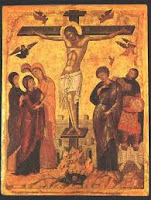 One of the more beautiful lines from John Wesley on redemption comes in his note on Colossians 1.14, "In whom we have redemption through his blood, even the forgiveness of sins." When it comes to themes and pictures of the atonement, this line illustrates a nice mosaic, expressing an array of layers at work in Christ's redemption via his death and resurrection:
 The voluntary passion of our Lord appeased the Father's wrath, obtained pardon and acceptance for us, and, consequently, dissolved the dominion and power which Satan had over us through our sins. So that forgiveness is the beginning of redemption, as the resurrection is the completion of it.
21 April 2011
From Distress to Composure
The scenes in the Garden of Gethsamene on the night of Jesus' arrest have always stood out to me. I cannot grasp what level of distress and sorrow that Jesus felt on the eve of his torturing and lonely death. St. Luke tells us that he was in such anguish that he began to sweat drops of blood (22.44). I just read a sermon by Dr. Mallett on prayer and he speaks of Jesus' cry in the Garden of Gethsemane:
The church never forgot that when Jesus was laying out his soul to God in the extremity of his inner anguish in Gethsemane, he summed up his relationship by crying "abba." This was not simply "father." It was much more familiar than that. Perhaps the first word a Hebrew child uttered would be "abba"-daddy.
It expresses and fulfills the intimacy conveyed in how he had earlier taught his disciples to pray, which included a prayer for deliverance from evil. When I have been teaching Sam to pray, I've used the words: "When trouble comes our way, rescue us." I'm sure this doesn't capture everything in Deliver us from evil/the evil one but I think it at least partly corresponds. It seems there is something of this in If it be possible, let this cup pass from me. But ultimately Jesus submits his will to that of his daddy and trusts that he will be with him, to strengthen him, in the midst of the trouble that is heading his way.
Then the story transitions from anguish to an almost unbelievable sense of composure and calmness in Jesus as he is arrested. I came across John Wesley's notes on how Jesus responds in the midst of being arrested...
The heroic behaviour of the blessed Jesus, in the whole period of his sufferings, will be observed by every attentive eye, and felt by every pious heart: although the sacred historians, according to their usual but wonderful simplicity, make no encomiums upon it. With what composure does he go forth to meet the traitor! With what calmness receive that malignant kiss! With what dignity does he deliver himself into the hands of his enemies! Yet plainly showing his superiority over them, and even then leading as it were captivity captive!
What a remarkable transition from anguish and distress to composure and calmness. With his daddy, Jesus is not afraid to pour out his soul in anguish. With his enemies who seek to do him harm, he is cool and graceful. His submission is immediately put to the test after his prayer and he is full of grace and mercy.
18 April 2011
Charles' Conversion Hymns: Guest post...
 If you're a returning reader to my blog, you've probably seen me make reference to Jonathan Powers, a doctoral student in worship studies at the Robert Webber Institute of Worship Studies. Jonathan is a gifted musician and insightful thinker into the relationship between theology and worship as you can read at his blog, Theology in Worship. He is also a Charles Wesley expert/scholar and I have enlisted his help on several posts and have enjoyed the correspondence we have shared during our studies. Jonathan was especially helpful in my recent series on the great Charles Wesley hymn, 'And Can It Be?' It is only fitting then that a good follow-up to that series would be written by him, so I am grateful for his input in what is below as he has gracefully taken time to write a guest post. Enjoy!
 Charles Wesley Conversion Hymns
Charles Wesley’s primary inspiration for his lyrical writing came from his own evangelical experience, one very similar to his brother John’s heart-warming experience.
In the month of May 1738, the Wesleys were in London. Charles was recovering from an illness in the home of some Moravian friends. On Pentecost Sunday, his brother John and some friends stopped by to visit Charles on their way to church. Later that morning, while in bed, opening his Bible to Isaiah 40:1, Charles felt God’s salvation come upon him. His Journal entry for May 21st reads: "I now found myself at peace with God, and rejoiced in hope of loving Christ..... I saw that by faith I stood, by the continual support of faith.......I went to bed still sensible of my own weakness....yet confident of Christ's protection." Just three days later - May 24th - John himself found assurance of salvation during a meeting in nearby Aldersgate Street.
Exactly a year after his own conversion experience, Charles wrote the famous hymn, “O for a Thousand Tongues to Sing,” which he recommended for singing "on the anniversary of one's conversion."
It was upon the experience of salvation in Christ that Charles Wesley began to find a specific message in his songwriting. Lyrical expression was more than a cathartic outlet. Instead, Wesley deeply felt the importance of communicating the theme of God’s universal invitation to salvation. Many of his hymns would thus reflect upon the experience on conversion. John Lawson writes, “It is natural to find that the Wesley hymnody contains a great volume of writing celebrating the glory of the conversion experience.”[1] With this personal assurance and experience of conversion, Charles began to place a new emphasis and power within his lyrical verse. John Tyson writes, “The bondage to sin and the darkness of doubt had been broken and driven away when Christ came into the poet’s life. Charles Wesley used images of manumission and liberation to communicate the freedom that he now felt because of his faith in Christ.”[2]
It is important to note that Charles saw his evangelical experience as a biblical one. Teresa Berger writes, “…the theme of God’s universal invitation to salvation is clearly at the foundation of Wesleyan preaching and the call to conversion.”[3] Often, Charles would reflect upon this experience by placing himself within certain passages of scripture. This is reflected in hymns such as “Come, O, Thou Traveler Unknown” and “And Can it be That I Should Gain?”
The first of these hymns, “Come, O, Thou Traveler Unknown,” is also known as “Wrestling Jacob.” Charles takes an “inside-out” allegorical approach within this hymn. He places himself inside the story as if it is part of his own testimony, and reinterprets the scripture thusly. In particular, “Wrestling Jacob” is a meditation on Charles Wesley’s own conversion through the story of Jacob and the angel found in Genesis 32:22-32. Charles becomes a figure of Jacob while the angel becomes a figure of Christ.
Though “And Can it be” is not as overt an allegory, Charles is still able to navigate through his own conversion by way of scripture. Verse four in particular reflects upon the freeing of the prisoners in Acts 12 as similar to Charles’ own experience of the freedom found in Christ. This verse may be one of the most robust verses in all of hymnody reflecting upon the transformative power of God’s grace.
Setting these reflections to hymn-form, Charles Wesley provided a scriptural language through which people of the church could reflect upon their own conversion experience while simultaneously worshiping God. Hence, for Charles Wesley the inner experience of salvation was manifest through lyrical praise of God.
[1] John Lawson, A Thousand Tongues: The Wesley Hymns as a Guide to Scriptural Teaching. (Atlanta, GA: Paternoster Press, 1987), 124-125.
[2] John R. Tyson, Assist Me to Proclaim (Grand Rapids: William B. Eerdmans Publishing Company, 2007), 50.
[3] Teresa Berger, Theology in Hymns?: A Study of the Relationship of Doxology and Theology According to A Collection of Hymns for the Use of the People Called Methodists (1780) (Nashville: Kingswood Books, 1995), 109.
16 April 2011
In Memoriam - And Can It Be?
And can it be that I should gain
That Thou, my God, shouldst die for me?
Over the last few days I've blogged some of my thoughts and interaction with the lyrics of what is often called the 'Fight Song' of Methodism: 'And Can It Be' (or 'Free Grace,' which was the title Charles Wesley first published it as). I posted an entry for each verse. Click on the verses above to go to each post.
But there is one more thing I wish to share with you about the significance of this song for me. Though I was raised in a Methodist church, I wasn't exposed to this song (that I can recall anyway) until I was in high school when a British Methodist evangelist, named Dr. Reginald Mallett, visited my hometown to preach at a cluster revival of the several nearby Methodist churches. You can read more about his ministry in this lovely article that was written immediately after his death last year. 

Dr. Mallett had a very attracting preaching style. Perhaps it was just the penchant for British accents that people like me have (I think he's the only person who has ever referred to me as a "fine young chap"), but I found his delivery very appealing as he would repeat the Scriptural text or hymn line to serve as transitions throughout his sermons. One such repetition was the opening lyrics of this hymn. I recall the clarity and exactness of his British accent as he recited the marvelous words of wonder at the depths of God's love that we should gain an interest in the blood of Christ.
My family was keen on welcoming visitors (esp. visiting preachers) to share meals with us after church services. Dr. Mallett and his wife joined our family at my grandfather's house on one of the evenings that week of the revival. I was in the midst of considering my educational path in route to ministry, when he suggested, "If you're going to seminary, be sure to give a good look at Asbury." That was the first time I'd heard of the school and his advice would return to mind years later when I pondered transferring from Murray State to finish my undergraduate work in Religion or Theology or Bible. So not only did he introduce this hymn to me, he was the first to introduce me to the name of the institutions that bear my undergrad and seminary degrees, even though his recommendation was from a distance.
I didn't speak with Dr. Mallett again for quite some time, but since I started my PhD program in a British institution and occasionally go to England for brief residency periods for intensive research, I decided to look him up during my visit this past June. I found that he was living in the southern portion of England (a few hours away from Manchester, where my school is). I also discovered he was on facebook and requested him as a friend. We finally connected via facebook and email my last day there last June. He expressed his greetings and warm memories from his time in my hometown. I got to share with him the memories of our brief interactions and that his few words played a part in my educational and vocational journey. It was my hope that I would get to travel down to his town to visit him on a future trip to England, but he passed away three months later (as you can see in the article above).
So I close my reflections of this great hymn in memory of Dr. Reginald Mallett, for he played a significant role in the life and path of this "young chap." I'm confident that Dr. Mallett is clothed in righteousness divine and awaits the final day at the marriage of the new heaven and new earth when he shall, like we, claim the crown through Christ our own!
Subscribe to:
Posts (Atom)